Alice in Wonderland: Am I the only one who…

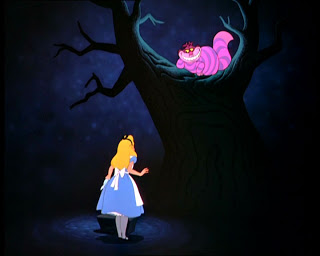
cheshire-cat-10

“We’re all mad here.”

Alice’s Adventures in Wonderland and Through the Looking Glass by Lewis Carroll
Published Nov 1865/1871 by Macmillan
Classic/Young Adult
Format: e-book; 161 pages
Also From This Author: The Hunting of the Snark, Jabberwocky
Goodreads | Amazon
My Rating: 3/5

…did not enjoy this book? I have only ever heard good things about Lewis Carroll’s Alice’s Adventures in Wonderland and Through the Looking Glass (I read them both), but try as I might, I could not get into them. I’m familiar with the story, because I own and love both Disney movie versions, so I automatically assumed that I would love the novel as well. I was sadly disappointed.

Currently I am fighting a cold, so I don’t have the creative energy to eloquently pen all of my opinions on Alice and her…strange…dreams, so allow me to sum them all up in the ever reliable Pros and Cons format!

Alice’s Adventures in Wonderland and Through the Looking Glass:

Pros: My favorite character, and perhaps the only one who never annoyed me, was the quizzical Cheshire Cat. I would have loved to see more appearances (and disappearances and reappearances) by him! I think the reason I loved him so much is because the Cheshire Cat is the most reasonable out of all the Wonderland creatures. The things he said actually did make sense.

Another character who amused me was of course the ever-popular Mad Hatter. Who doesn’t love him? I would have also appreciated more scenes with him, so I thank Tim Burton for fulfilling that desire in his 2010 film.

Fortunately, the live flowers weren’t quite as annoying in the novel as they are in the animated movie. Along with the little skit about the Walrus and the Carpenter, the live flowers bit is my least favorite scene in the movie.

Cons: Parts of this book honestly gave me a headache, mainly because it was really hard to follow. It’s like reading about a dream someone had after taking one too many Benadryl, which is actually probably why a lot of people like this story. I understand its uniqueness as a work of literature and I appreciate Carroll’s ability to break conventionality, but I have come to realize that books written in this type of nonsensical format are not my cup of tea. I might be inclined to put Alice on the same bookshelf as Coleridge’s Kubla Khan, although if I had to choose between the two of them, I’d much rather read Alice.

Another con was that so many of the characters drove me insane. Alice, for one…I could not connect or relate to her on any level. And the Red Queen was undoubtedly my least favorite (main) character, although that’s not surprising to me since she’s also my least favorite character in the animated movie as well (Helena Bonham Carter makes her more likeable in the live-action film, at least in my opinion). Why was she in the story so much?

Other characters I did not appreciate were the White Queen and the White Knight, whom I really did try to like! Mainly because I pitied his clumsiness.

Quotes:

Alice had got so much into the way of expecting nothing but out-of-the-way things to happen, that it seemed quite dull and stupid for life to go on in the common way. [Alice’s Adventures in Wonderland chapter 1]

  • Love this. Let’s all be always expecting the unexpected :)

“It’s rather curious, you know, this sort of life!” [Alice’s Adventures in Wonderland chapter 4]

  • There was a nice group of little quotes like this one that helped me like the novel in some ways.

Suddenly, a footman in livery came running out of the wood–(she considered him to be a footman because he was in livery: otherwise, judging by his face only, she would have called him a fish)… [Alice’s Adventures in Wonderland chapter 6]

  • There is no significance in this quote other than the fact that it literally made me laugh out loud.

“We’re all mad here. I’m mad. You’re mad.” [Alice’s Adventures in Wonderland, chapter 6]

  • Ain’t that the truth, Mr. Cheshire Cat.

“Where do you come from?” said the Red Queen. “And where are you going?” [Through the Looking Glass, chapter 2]

  • After reading this line, the lyrics to “Cotton-Eyed Joe” were stuck in my head for a while…thanks to a recent episode of The New Girl (sorry! I love when my worlds collide!)

Closing Thoughts:

I know that I may have been a bit all over the place with this post, but it’s about Alice in Wonderland so anything goes! Honestly, it wasn’t the worst book I have read (I rated it 3/5 stars on Goodreads), but it was a big disappointment for me. That’s what happens sometimes when you set your expectations high. I should have approached it like I did Jane Eyre, which I thought I would hate and now it’s one of my favorite novels.

Jane Eyre Chapters XXX-End

Jane Eyre by Charlotte Brontë
Published Oct 1847 by Smith, Elder, and Company
Classic/Romance
Format: e-book; 332 pages
Also From This Author: Villette
Goodreads | Amazon
My Rating: 5/5

It’s hard to believe that this is the last day of September, and with it comes my last Septemb-Eyre post! It has been so wonderful spending these past few weeks discussing Jane Eyre with a great group of different bloggers. I have generally felt as if I was a part of a digital book club! Not only have I found a “new” book that I adore, but I have also made some new friendships along the way. So, without further ado, here are my remaining opinions of Charlotte Brontë’s Jane Eyre →Spoiler alerts for anyone who has not read Jane Eyre in its entirety←

Let me start this post by stating that this is one of the happiest endings I have ever read in a novel before! Even though both Jane and Mr. Rochester have suffered immense tragedies and heartbreaks in their lifetimes, by the time Chapter 38 rolls around, our tortured lovers are finally, and forever, happy :) I believe a lot of that has to do with the way Jane finds happiness. She doesn’t chase after it, but rather, she lets her morals and her conscience guide her, and eventually happiness finds her, and it is better than if she had sought it out herself.

To further elaborate my point, I give to you my unofficial “Jane Eyre Spectrum of Human Intention”:

  • On the far left we have Mr. Rochester: bold and extravagant “bachelor” who appears to be guided nearly exclusively by his feelings and emotions. He tosses conventionalities and morals aside after his wife inevitably succumbs to her madness. In his lifetime he has had several mistresses and at lasts falls in love with his “equal and likeness” (I just loved those lines), Jane. Tragically, this love affair is doomed from the beginning, and when Mr. Rochester’s attempt to commit polygamy is revealed, Jane flees despite Mr. Rochester’s tempting propositions of turning her into his mistress.
  • On the far right we have St. John Rivers: religious fanatic who is guided completely by “reason, and not feeling” (Chapter 32). He denies himself a marriage of love in exchange for one solely based on duty and practicality, and he even tries to blackmail Jane into submitting to his beliefs as well. During the third act of the novel, St. John does behave in Christian-like ways (by taking Jane in, getting her back on her feet, and employing her), however, he also treats her with coldness and authoritativeness as opposed to brotherly love, all in a desire to mold her into the perfect missionary wife.
  • Finally, smack dab in the middle we find Jane Eyre herself, who morally does what is right but who also never sacrifices her heart. (Now, I know that Jane confesses to us readers that she has never known what it is to be moderate, but I believe in the case between strictly following reason vs. strictly following feelings, she falls in the middle.) Throughout the novel, Jane fluctuates between emotional outbursts and fleeing from fleshly temptations, however, she lives by this motto: We need to always choose the path of the morally right, no matter how difficult. She looks to God and not to man regarding matters of conscience, and thus she is abundantly blessed because of all that she has overcome.

Jane overcomes more obstacles, tragedies, sufferings than any other character in this novel. She is unwavering in her principles and morals, she is unwavering in her faith in God, and she is unwavering in her philosophy that all persons on earth are equals, despite differences in class, wealth, education, and other ranking systems. One of the themes that stuck out the most to me while reading Jane Eyre was actually quoted in a line by St. John: “He that overcometh shall inherit all things” (Chapter 35). I just love how beautifully this theme is woven throughout all of the occurrences in Jane’s life. Never once did she face something that was too difficult to overcome; never once was she beaten by temptation, failure, or injustice, and why was that? Because she was guided by moral purity, selflessness, forgiveness: Christian principles that Brontë comments on regularly throughout her novel.

Another religious idea that Brontë discusses in this book is foreign missions. Jane and St. John’s characters are very similar in the idea that they both have a desire to serve others. However, they differ greatly in their opinions of how best to serve others. St. John essentially tells Jane that by not marrying him, she cannot become a foreign missionary, and thus she is denying God the ability to work through her. In his eyes, Jane was disobeying God. However, Jane has skills that she had already been using to help those even less fortunate than herself, and by the end of the novel we see how she will be able to serve another soul in need. I believe that Brontë implies that foreign missions are not a bad thing, they are simply not for everyone, and also, by not becoming a foreign missionary, it does not mean that one is “unusable” by God. Every country has a need, and every person can serve others, whether they stay in their home country or they go to another country.

Back to Jane and the subject of equality: before leaving Thornfield, Jane was Mr. Rochester’s equal, though not in class, wealth, or even physical capability. When she returns to Mr. Rochester, she is an independent woman, with respectable family ties (family that actually claims Jane as their own), and she has the ability to serve as Mr. Rochester’s physical helper–this is something that can be viewed as Jane wanting some type of power over her husband, but I absolutely loved what Jane says during the concluding chapter:

“I hold myself supremely blest–blest beyond what language can express; because I am my husband’s life as fully as he is mine. No woman was ever nearer to her mate than I am: ever more absolutely bone of his bone and flesh of his flesh. I know no weariness of my Edward’s society: he knows none of mine, any more than we each do of the pulsation of the heart that beats in our separate bosoms; consequently, we are ever together. To be together is for us to be at once as free as in solitude, as gay as in company. We talk, I believe, all day long: to talk to each other is but a more animated and an audible thinking. All my confidence is bestowed on him, all his confidence is devoted to me; we are precisely suited in character–perfect concord is the result” (Chapter 38).

I have to admit that while reading the final two chapters I had a permanent grin stretched wide across my face and tears shining in my eyes. So many emotions were going on! This book had me in tears when Mr. Rochester was doubting Jane’s realness, as if he was only imagining that she had returned to him. And one of my favorite parts about this reunion scene is when we discover how worried Mr. Rochester was for Jane’s life after she fled. This is another redeemable quality we find in our tortured hero that is discovered late in the novel because of Brontë’s use of first-person narration. (side note: I feel like I have talked about POV so much with this novel, but honestly, I really do think first-person narration is my favorite. It creates mystery, suspense, and tension…novels are incredibly interesting when we are only privy to one character’s thoughts, feelings, and desires!)

I should not have left him thus, he said, without any means of making my way: I should have told him my intention. I should have confided in him: he would never have forced me to be his mistress. Violent as he had seemed in his despair, he, in truth, loved me far too well and too tenderly to constitute himself my tyrant: he would have given me half his fortune, without demanding so much as a kiss in return, rather than I should have flung myself friendless on the wide world (Chapter 37).

I absolutely loved so many parts of this last section, and in between the tears I was literally laughing out loud when Jane and Mr. Rochester returned to their old teasing ways. I’m sure I’m not alone in cracking up because of Mr. Rochester’s jealousy over St. John? I would quote the entire exchange between Jane and Mr. Rochester, when he is trying to uncover information about Jane’s cousin, only it is too long…but I was laughing to myself during that entire passage.

And then, it touched my heart when Mr. Rochester stopped to thank God for reuniting him and Jane:

“I thank my Maker, that, in the midst of judgment, he has remembered mercy. I humbly entreat my Redeemer to give me strength to lead henceforth a purer life than I have done hitherto!”

Like I said in the beginning of this post: Jane Eyre has one of the happiest endings in any book I have ever read! And finally, one thing I really loved most about this novel was how everything came together: every single incident in this novel needed to happen for all the ones succeeding it to happen, and I thought Charlotte Brontë did a wonderful job as an author to make that seem effortless.

Well, I actually finished reading this novel during the first week of our Septemb-Eyre read along, but I have still been doing Jane Eyre themed things this month, including watching 4 different adaptations! I will briefly sum up my opinion about each one, beginning in the order I watched them, which also happens to be reverse chronological order: →Spoilers for Jane Eyre movie adaptations for those who have not yet seen them←

Jane Eyre (2011)

JaneEyre2011

I had heard only negative things about this film before I actually watched it, but fortunately I finished the novel beforehand, and I think that really aided me in liking this film. I was able to fill in gaps because there were a lot of things missing, especially regarding characters’ qualities.

Pros: The acting was superb; the cinematography was beautiful; I loved the music; the script was well-written; I loved the way this film was edited–one of my favorite parts was when the Rivers ask Jane for her name and we hear John Reed creepily call out, “Jane Eyyrreee…” before it flashes back to Jane’s childhood.
Cons: Mr. Rochester seems controlling and possessive, his sarcasm is more dark than it is witty; Bertha is practically cut out of the story; they leave out the best parts about the ending! It feels like a happy ending, but not entirely.

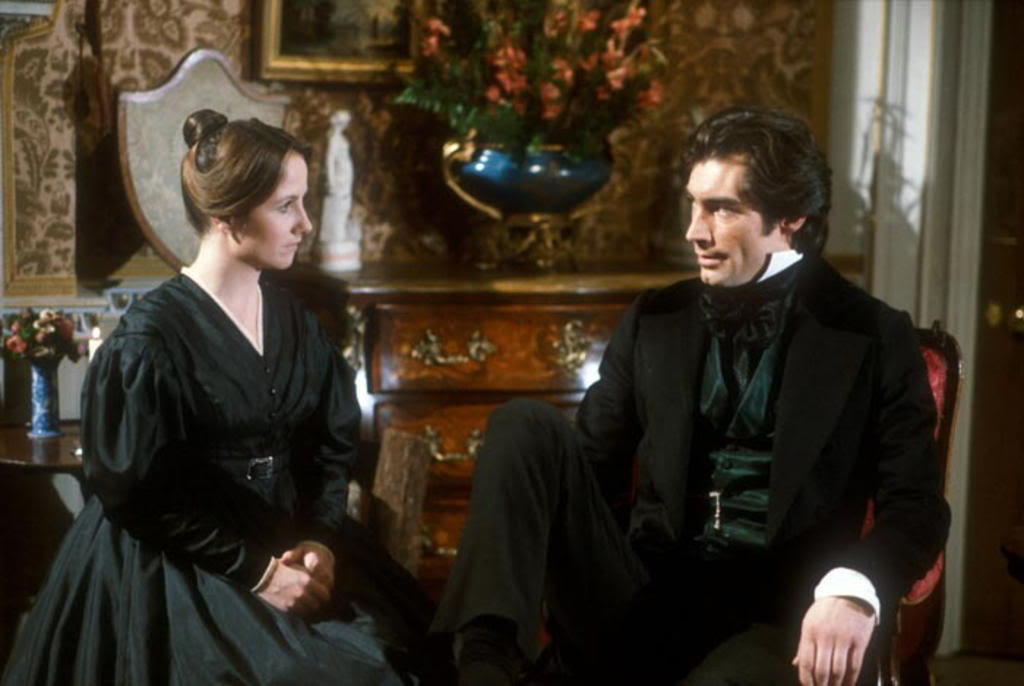
JaneEyre2006

Jane Eyre BBC Miniseries (2006)

This was probably my favorite adaptation, mainly because Mr. Rochester was just like Mr. Rochester in the book. This miniseries was very true to the novel, and only a few things were cut out or changed, some better than others.

Pros: Rochester is wonderfully portrayed–he’s sarcastic and witty to the point I was laughing out loud several times during his scenes, especially when Jane makes him jealous at the end! (the scene pictured here); the costumes were BEAUTIFUL; I loved the way they adapted the gypsy scene.

Cons: They gave Jane amnesia after fleeing Thornfield?; the whole post-wedding scene was weird in general–Jane wasn’t as adamant about leaving. In that scene, she didn’t seem as strong as novel-Jane. And parts of that scene were cheesy…
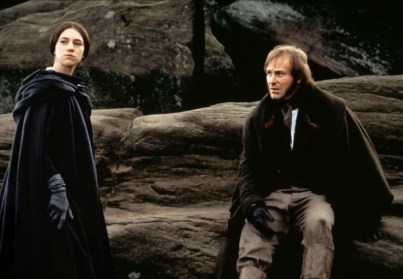
JaneEyre1996Jane Eyre (1996)

This was probably my least favorite adaptation out of the four that I watched. I don’t even remember much about it, to be honest, and I think that is because nothing really stood out, although there were some good parts.

Pros: I liked the actress playing Jane–she wasn’t an amazing actress or anything, but I did like her; I also liked the actress playing Mrs. Fairfax.

Cons: I did not like the portrayal of Mr. Rochester–although he was still proud and sarcastic, he seemed too nice at the same time; the ending was changed from the novel a little bit to my disliking.

Side-note: Amanda Root plays Miss Temple in this version, and she also plays Anne Elliot in my favorite adaptation of Persuasion; Sally Hawkins, who played Anne Elliot in the 2007 version of  Persuasion, portrays Mrs. Reed in the 2011 adaptation of Jane Eyre. Pretty cool :)

JaneEyre1983

Jane Eyre BBC Miniseries (1983)

I loved this version, and it might have something to do with the fact that I have had a crush on Timothy Dalton since I was a little girl (I know…he’s like 70 years old now, but he was in an older version of Antony and Cleopatra that I watched at my grandma’s house one summer growing up and yeah…he’s pretty handsome).

Pros: Timothy Dalton is a fantastic actor–he’s does a wonderful job at portraying Mr. Rochester’s changeable behavior; this adaptation follows the novel very well, they even do the gypsy scene with Timothy Dalton dressed as an old lady! Finally!

Cons: like I said before, Timothy Dalton is handsome–too handsome to be Mr. Rochester; Jane’s character is missing some “Janeness” (she’s not as firm; also, some general film problems: the lighting is not good (lots of shadows), and the sound is off at times. Also, at Lowood they ring the bell for way too long, I was wanting to mute the volume!

Jane Eyre Chapters XXII-XXIX

Jane-Eyre-2006-miniseries-jane-eyre-1618969-1024-576

This is how I felt after reading chapter 27…

This was one of the most heartbreaking sections of a novel I have ever read. Maybe it was hormones, maybe it was stress, or maybe it was simply the fact that Charlotte Brontë was an incredible writer…but I was a wreck while reading parts of this week’s chapters, and it has taken me many days and revisions to write this post due to the whirlwind of emotions involved. So, let’s go and relive it all, shall we? [Spoilers ahead for chapters 22-29 of Jane Eyre]

This section jumped into the deep stuff right away, beginning with one excessively emotional proposal, which I loved, even though Mr. Rochester appeared rather cryptic. I really appreciated Jane’s outburst at Mr. Rochester as I feel it resembled her previous outburst towards Mrs. Reed [“You think I have no feelings, and that I can do without one bit of love or kindness; but I cannot live so” (Chapter 4) // “Do you think I am an automaton?–a machine without feelings…?” (Chapter 23)]. However, Mr. Rochester, unlike Mrs. Reed, recognizes Jane as an equal, and I loved when he said, “And your will shall decide your destiny,” (Chapter 23): This is one of his redeemable qualities, the fact that he has constantly viewed Jane as an equal. In this proposal scene, he puts all of the power and the decision in her hands. Since their first “fireside chat” he has encouraged her to speak her mind freely, and in Chapter 23 he asks her to share her heart freely as well, without the constraints of class or convention.

Last week I touched on a similarity in themes between Pride and Prejudice and Jane Eyre (first impressions; not everything is as it appears to be). I couldn’t elaborate at that time, in order to avoid spoilers, but now I can safely finish discussing my thoughts. In Jane Austen’s novel, the story is told from a third person point of view. While we mainly see things from Elizabeth’s perspective, there are quite a few instances where we get to hear Mr. Darcy’s thoughts, and this is why we are not completely shocked and confused by his romantic confessions to Elizabeth. We understand everything that is going on between both characters. In Jane Eyre, however, the story is narrated from the future by Miss Jane herself, and therefore we find ourselves confused by Mr. Rochester in more than one way. Also, there are several exchanges between Jane and Mr. Rochester that are only dialogue; no description of the characters’ tones, deliveries, or appearances are given, which makes it harder for readers to tell when they are being serious or playful.

This is the type of novel that I believe only improves upon rereads (so I am looking forward to rereading it someday!), because it is upon rereads when we are able to fill in the gaps and understand why Mr. Rochester speaks and behaves the way he does. To the first-time reader, Mr. Rochester seems cruel, cold, and even manipulative (Jane herself questions why Mr. Rochester flaunted fake affections towards Miss Ingram when they both knew he didn’t love her–side note: I love how Jane selflessly feels sympathy for Blanche’s feelings! Jane, why are you so good-hearted?). After all, Mr. Rochester did attempt to take a wife while secretly hiding his current, mentally ill wife in his attic; that does not make him appear less manipulative. However, I feel that after we read his confession, his strange demeanor and speeches start to make sense. I believe that Mr. Rochester is not bad, but tortured, because he has spent a great many years of his life in an internal battle between what is right and what is not: more specifically, what is right by conventional standards versus moralistic standards and sometimes versus Godly standards. Convention says he should marry Blanche Ingram; his morals view Jane Eyre as his equal, despite their differences in class and wealth; God says that bigotry is a sin. Mr. Rochester has spent the past fifteen years of his life battling all of these issues, trying to find a balance that brings him peace and pleasure. However, the doomed outcome to this philosophy was foreshadowed back in Chapter 14, when Jane warns Mr. Rochester that seeking pleasure out of life will cause him to “degenerate still more.” Yes, this is definitely a reread type of novel.

Going off that reflection, one of my favorite parts about this particular section was how firm and unwavering Jane was in her moral convictions:

“Laws and principles are not for the times when there is no temptation: they are for such moments as this, when body and soul rise in mutiny against their rigor; stringent are they; inviolate they shall be” (Chapter 27).”

This is why Jane is such a wonderful role model for young girls and women! I know I am not alone in wishing I had read this novel back in high school…

So, to conclude: do I think Mr. Rochester is justified in his deceitful actions? No, absolutely not. But I can understand what Jane means when she says this:

“Reader, I forgave him at the moment and on the spot. There was such deep remorse in his eye, such true pity in his tone, such manly energy in his manner; and besides, there was such unchanged love in his whole look and mien–I forgave him all” (Chapter 27).

Jane does know Mr. Rochester better than anyone else, better even than us readers. And since I have already finished the book (don’t worry–no spoilers!), I can attest to the fact that there is still more for us to discover about both Jane and her tortured lover.

Hopefully I can explain my opinions more clearly in my next (and last!!) Jane Eyre post. This post was unusually difficult for me to write coherently, so I apologize for my scattered thoughts. Feel free to leave a comment below with any questions, clarifications, or your own commentary on understanding Mr. Rochester!

Jane Austen’s Emma

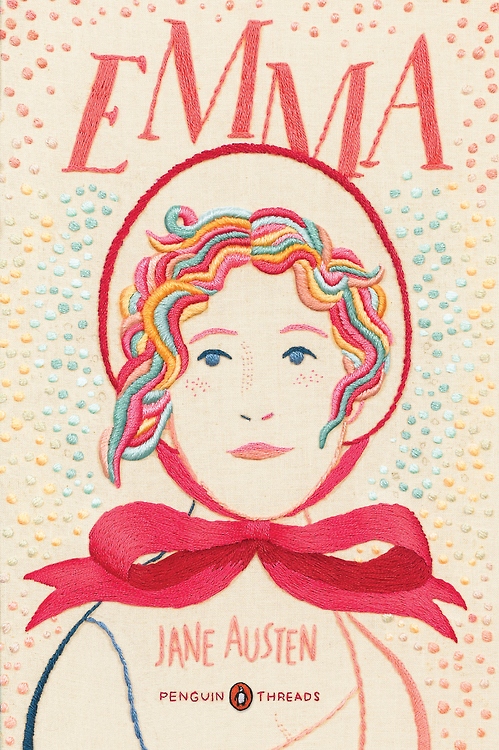
tumblr_mss4csHCJ21ssrt9xo1_500

I wish all books were this pretty!

Emma by Jane Austen
Published Dec 1815 by John Murray
Classic/Romance
Format: e-book; 456 pages
Also From This Author: Pride and Prejudice, Sense and Sensibility, Northanger Abbey, Mansfield Park, Persuasion
Goodreads | Amazon
My Rating: 4/5

This summer I was on a Jane Austen spree; I read Persuasion, Pride and Prejudice, Mansfield Park, and finally Emma. It was my first time reading it, although I was already familiar with the story because of the 1996 film version (featuring the worst period-era wig ever, courtesy of Ewan McGregor).

churchill

Seriously, he looks like the Mad Hatter.

But I never really liked Emma as a character. She’s snobby, meddlesome, and rather immature (like when she gets upset at not being able to decline an invitation because she wasn’t even invited…ugh). However, after finally reading the novel I actually came to *like* Emma, or maybe I just really liked Mr. Knightley ;) His speech near the end was so sweet, and I love this little excerpt afterwards:

He had ridden home through the rain; and had walked up directly after dinner, to see how this sweetest and best of all creatures, faultless in spite of all her faults, bore the discovery. (Chapter 49)

So there were great, swoon-worthy parts of the novel. But the worst, the worst part about Emma is the Box Hill picnic, when Emma maliciously makes fun of Miss Bates in front of all their friends. Because I had already seen the 1996 movie before reading the novel, I was dreading, absolutely dreading that chapter the entire time. And while I was watching the movie again after finishing the novel, I even muted the TV for a good minute and a half during that one excruciating part. There are a handful of books that contain chapters which I dread reading that much, but at least we are able to truly see Emma’s repentant heart afterwards.

Jane Austen’s novels frequently convey the motif of misunderstandings, and Emma is stock-full of them. She misunderstands the attentions and actions of Mr. Elton, Mr. Frank Churchill, and if that isn’t enough, Mr. Knightley as well. Clearly Emma does not possess an appropriate skill-set in order to be a successful matchmaker. Each of Emma’s misunderstandings add to the humor and drama of the plot, but they also help Emma to mature before the reader, and while I started the novel with the opinion of Emma being vain, selfish, and snobby, I ended it admiring Emma for her kind heartedness, compassion, and humility. There were two instances in which I loved Emma the most, the first being after Mr. Elton’s proposal, when Emma feels worse for her friend Harriet than she does for herself:

Every part of it brought pain and humiliation, of some sort or other; but, compared with the evil to Harriet, all was light; and she would gladly have submitted to feel yet more mistaken—more in error—more disgraced by mis-judgment, than she actually was, could the effects of her blunders have been confined to herself. (Chapter 16)

I absolutely admired her selflessness in this passage, and it added greatly to my sympathy for Emma in the second instance, near the end of the novel, when she suspects Mr. Knightley is about to confess his feelings for Harriet. At first Emma silences Mr. Knightley, but then, seeing how she has pained him, puts her duty as a friend over her own heartbreak, and pleads for Mr. Knightley to speak of anything he would like to. That must have taken immense courage.

I am very glad I gave Emma another chance. Even though I would not consider it my favorite Jane Austen novel, nor would I consider any of the characters my most favorite or least favorite, it was an enjoyable read with memorable themes and humorous indirect dialogue, without which I doubt I would have been able to laugh at or sympathize with our headstrong heroine.

Jane Eyre Chapters XII-XXI

Here is my post for Part II of the Jane Eyre read-along I’m participating in. Prepare yourselves for a longer than usual post, because I have many Jane Eyr-ie things to discuss today (and also, my husband loves to purposefully call the novel Jane Eyrie and play it off with the “I’m French” card)! I’ve actually had to write this post early (it is currently Thursday) since I can’t seem to put this book down, and I want only to talk about chapters 12-21 without interference from future plot happenings (especially because things are really starting to get good!). →So, from this point on, take caution if you have not read up until Chapter 21 of Jane Eyre. I would hate to have anything spoiled for you!←

As you can tell, I am loving Jane Eyre. I did not think it possible at first, so I would like to make an addendum to the old saying and propose instead to say: “Never judge a book by its beginning chapters.” Okay, that can’t quite be applied to every novel, but I will apply it to my first impressions of Jane Eyre, and I think it is rather fitting, since I have heard of the novel being compared to Pride and Prejudice, which was almost titled First Impressions. The shared theme runs deeper than that, but I will elaborate further on that next week.

Last week (I smile at that, knowing I will most likely already be finished with the novel by the time I publish this post) we left our beloved Jane–yes, I have come to adore our intriguing heroine!–in unusually hopeful circumstances. Dun, dun, dun! Obviously this is foreshadowing. Jane herself says that “happiness is irrevocably denied” to her (chapter 14). BUT I am in simultaneous hope and fear as I continue reading. This is why I love Gothic lit, you’re always kept on the edge!

I love how this novel is narrated by Jane herself. It gives us appreciative insight into the workings of her mind. One of my favorite instances of this is actually two separate yet intertwined passages. When Jane first confesses that she is developing feelings towards Mr. Rochester, she attempts to subdue them by focusing on her employer’s romantic opportunities. Jane then uses a portrait she sketched of Blanche Ingram in order to point out her own shortcomings, essentially to remind herself of her place and her own meager opportunities. In this chapter Jane views herself inferior and beneath Blanche and Mr. Rochester (whom she also feels unworthy of). However, and I loved this part, two chapters later, once Jane has met and observed the accomplished Miss Ingram, her attitude towards her has changed drastically.

“There was nothing to cool or banish love in these circumstances, though much to create despair. Much too, you will think, reader, to engender jealousy: if a woman, in my position, could presume to be jealous of a woman in Miss Ingram’s. But I was not jealous: or very rarely;–the nature of the pain I suffered could not be explained by that word. Miss Ingram was a mark beneath jealousy: she was too inferior to excite the feeling. Pardon the seeming paradox; I mean what I say.”

BAM! And this is when I came to really admire Jane. She sees people solely for their inward qualities, their actions, their treatment of others. Appearances no longer matter to her, and conventionalities are beginning to lose their influence as well. And yes, we could also state that Jane, although she denies it, does exhibit feelings of jealousy. After all, they do desire the same man’s affections, right? But no, Jane is not jealous (or as she says, “very rarely”); if anything she is disturbed by the idea of Mr. Rochester marrying anyone undeserving of his affections. How beautiful a reaction is that! It doesn’t ring of jealousy; it displays a mark of true love.

And what of the compelling Mr. Rochester? I have come to like him a great deal, as well, yet there is something I’ve been having a difficult time understanding: can anyone please explain to me why Rochester did not reveal to Jane who he was during their meeting on the road? I believe it ties in with the gypsy scene; clearly he has a thing for disguises and secrets, but I could not help but think how awkward I would have felt in Jane’s place, yet she doesn’t even question his beguilement…why? Does he act this way simply because of his standoffish persona, or is it because of his troubled history, which Mrs. Fairfax briefly explains to us?

I had also wanted to discuss Jane’s visit to Gateshead, but I would be more interested in reading YOUR thoughts instead. How did you react to that chapter? What observations did you make about Jane’s aunt and cousins, or even about Jane herself? Tell me in the comments or in your own post!

Last week I left you readers with some crossover memes. This week I will be signing off with a humorous little ghost story that happened to me the other night. Like the typical bookworm that I am, I was awake until nearly two in the morning reading Jane Eyre. It happened to be the chapter when Mr. Rochester’s room is arsoned, so already I was in a heightened state. I should mention here that the weather in my corner of France has been beautifully autumnescent (I do not believe that is a real word, but feel free to add it to your vocabulary nonetheless) as of late, which goes hand in hand with a story like Charlotte Brontë’s:

1234759_10151819673348886_422485767_n

Ahh…I wish half the year was spent in fallen leaves and the other half in fields of wildflowers.

So, while reading late at night with the window ajar and the fresh air flowing my bedroom, I was just passing the part when Jane has to wait alone in Mr. Rochester’s smoke-filled, water-drenched chamber when I started to faintly hear the eery soundtrack of an old black-and-white film being played somewhere in our apartment building. Now, in most cases, classic film music is lively, joyful, and nostalgic. For me, it was certainly recalling old memories…but memories of watching “The Twilight Zone” or passing through scare zones and haunted houses at Halloween Horror Nights. Needless to say I quickly shut the window, finished my chapter, and buried myself in the comforts of my covers before any chainsaw wielding maniac could seek me out. Nothing like a gothic ghost story to send you off to dreamland… (I also just realized how fittingly this story coincides with Anne Shirley’s Haunted Wood mishap in Anne of Green Gables: I’m letting my overactive imagination run away with me!).

Happy Reading everyone!

Septemb-Eyre

OLYMPUS DIGITAL CAMERALast month I participated in an online read-along for Mansfield Park. I enjoyed it so much that I decided to join another one this month for Jane Eyre, which I have never read before. This novel is also on my Classics Club list, so I figured that it would be more fun to read it with other bloggers than by myself. I actually don’t know much at all about the story and I have never seen any film adaptations. I have heard mixed reviews about this novel, but hopefully I end up enjoying it. And hopefully I am able to keep up with the weekly readings (I have to read the first 11 chapters for next week’s post)!

If any of you are also interested in reading along, here’s the link to sign up and here’s the link for the first week’s introductory postings.

Mansfield Park Part 3

Mansfield Park by Jane Austen
Published July 1814 by Thomas Egerton
Classic/Drama/Romance
Format: e-book; 502 pages
Also From This Author: Pride and Prejudice, Sense and Sensibility, Emma, Northanger Abbey, Persuasion
Goodreads | Amazon
My Rating: 4/5

Here is the last group of questions from the Mansfield Park read-along that I have been participating in. I mentioned this in my previous post, but I loved the novel and really connected with Fanny Price (shocking, I know). I completely understand if no one understands my reasoning, but I’m glad I enjoyed it so much; I would hate to dislike an Austen novel.

Mansfield Park Discussion Questions (Chapters 32-48)

  • Please, please discuss the entire Henry Crawford fiasco. Anything that you most want to discuss – his falling for Fanny, his proposal and her refusal, the reactions of those around them, etc. Consider also: Fanny in Portsmouth, Henry in Portsmouth, and Fanny’s steadfast refusal, and the return to Mansfield. Lots to discuss with this one! Wow. I felt so awkward and sympathetic for Henry. A big part of me wanted Fanny to give him a chance!! He starts off as a much more interesting character than Edmund, but later on he started getting creepy…especially when he just showed up in Portsmouth. Awk-ward. And also that one scene at Mansfield Park when he keeps badgering Fanny to tell him what she was thinking: I wanted to shout “Back off, man!” Seriously, some men cannot take a hint.
  • Perhaps one of the biggest points of contention for readers of Mansfield Park is the Crawfords. Though Fanny may look like a prig beside them, they are the only ones throughout the novel to truly appreciate her and praise her. Do you feel their esteem is genuine? Why do you think no one else appreciates Fanny for most of the story? And do you think the esteem which some characters show her in the end will last? I disagree that the Crawfords are the only ones who appreciate Fanny. I do believe that Edmund appreciates and praises her, too. And you can tell by the end of the novel that her aunt and uncle Bertram have grown to appreciate her as well. That being said, I do not believe the Crawford’s esteem is genuine because it is not reflected in their actions. After Mary moves away she hardly writes Fanny (not that Fanny is upset by that), and this describes an “out of sight, out of mind” attitude. Plus, Mary’s motive for spending time with Fanny is usually so that she can talk about or garner information about Edmund. Not exactly genuine. Henry, on the other hand, seems more sincere for the most part. He fails in his lack of humility. He does not let his actions speak for himself. If you compare him with Austen’s other heroes, for example Mr. Darcy, Colonel Brandon, and Captain Wentworth*, we see that they act behind the scenes and it is not until later that the corresponding heroines discover their true and praise-worthy characters. Perhaps if Henry had done something truly selfless and it was revealed to Fanny through a person other than himself, then maybe she would have considered his esteem as genuine (and maybe even considered him as a suitor).
  • Mansfield Park as a story wouldn’t exist without the actions and marriages of the original three sisters (now Lady Bertram, Mrs Norris and Mrs Price, respectively); each are very different in character, and each have made very different matches, setting the tone for everything that follows. What do you think of these three women and who they’ve become? Do you see any similarities between them – a free-spirit who marries imprudently, an emotionally-stoic, proper woman who marries very well, and a bitter, interfering curmudgeon who marries well enough – and other Austen characters? How do you imagine these three have changed over the course of their lives? And how did their story play out over the course of this book? I feel that Austen’s usual motifs of sense and reason are portrayed here as well. The only one of these sisters who ends off “well” would be Lady Bertram. Obviously she is not an ideal character; she is lazy and generally naive to what is going on around her. However, she is the only sister who undergoes a change during the course of the novel. By the end she has come to view Fanny as an actual family member, and even more, as her daughter. My optimism is determined to believe that the Bertrams (aside from Maria) all go on to have happy lives.
  • One of the things we’ve talked about quite a bit this Austen in August is the idea that Mansfield Park is much less a love story, less a story of romance, than people would generally have you believe. What do you think of this? Do you find it a solid romance, or do you think that’s merely a surface story, with a much deeper shadow story playing underneath? I absolutely agree that it is not a romance. If you are looking for a novel like Pride and Prejudice (which I happened to finish right before reading MP but thankfully I jumped into it already knowing what I was getting into), then you will be sorely and unfortunately disappointed. It is NOT a love story. In fact, the focus of the novel is not intended to be on Fanny and Edmund’s relationship whatsoever. I believe Austen uses this novel more than any other as a critique, and her opinions on life and society can clearly be traced through Fanny’s character development and the strong contrasts between Fanny and the other characters. I read that the psychological “Nature vs. Nurture” debate was active during Austen’s lifetime, and there are many instances in the book that reflect a pro-nurture attitude. There is even one point in the novel where I believe Edmund states that Mary would have turned out better had she been raised differently (“they continued to talk of Miss Crawford alone, and how she had attached him, and how delightful nature had made her, and how excellent she would have been, had she fallen into good hands earlier,” Chapter 47). And even though Fanny comes from a more “savage” gene pool, she is given a proper upbringing where she is denied luxuries and indulgences while her cousins are spoiled and never discouraged in their selfish indulgences. And in the end Fanny is proved to be the better mannered and more valued character while her cousins are ruined and scandalized. 
  • Now that we’ve read Mansfield Park in its entirety, are there any characters or aspects of the book that are generally disliked, which you’d like to defend? How do you feel about the respective marriages/pairings/endings for everyone? Is there anything you’d change, if you could? I really wish that Julia had not eloped with Mr. Yates. I wish she would have been more sensible in that regard. I would have liked for her to have been redeemed from her original character at the start of the novel. But other than that, I loved the novel and how everything turned out, even Fanny ending up with Edmund. Sometimes love takes years to bloom. Fanny loved Edmund since she practically arrived at Mansfield Park, yet Edmund needed more time than that. This is what makes the novel realistic, because not every relationship is a fairy tale.
  • If you’ve read other Austen novels, how do you think Mansfield Park compares or contrasts to the rest of Austen’s work? (class mobility, likeability, class represented, tensions, etc. compatibility of romance, ending, etc.) I believe it is very similar to Austen’s other works, but perhaps it is “more strongly concentrated”. It cuts out the swoon-worthy romance and intensifies the themes and commentaries.
  • If you’ve seen any of the movie adaptations, what do you make of them? Mansfield Park adaptations are notorious for making massive changes, especially to the character of Fanny (to make her more “likable,” more feisty, to connect more with a modern audience); do you think this is necessary? Does making Fanny more “feisty” lessen the impact of the story? I have only seen the 2007 adaptation, which I did enjoy despite the changes. I mentioned in my last post how the trailer from the 1999 adaptation describes Fanny as “spirited”. That poor-description has turned me off from even giving that adaptation a chance.
  • Is there anything else you’d like to discuss from Volume Three, or the novel as a whole? Yes! A couple of things. Firstly, I appreciated how the ongoing references to the play reminded the reader that many of the characters are acting. Unfortunately for Edmund, Mr. Rushworth, and Maria, they are respectfully deceived by Mary Crawford, Maria, and Henry Crawford. Fanny is cleverly able to see through Henry’s disguise, and she keeps control of her feelings so as not to fall victim to his flirtatious nature. Secondly, I loved how Jane Austen wrote the last chapter from her own point-of-view. It gave me shivers to hear her say “my Fanny”. I felt very connected to Austen during that last chapter, almost as if I was listening to her read the book aloud.

*to clarify, I mean Mr. Darcy’s dealings with Mr. Wickham, Colonel Brandon’s with John Willoughby, and Captain Wentworth’s secretive affections towards Anne (when he asks his sister and brother-in-law to drive her home and also when he has that message delivered to her just after Louisa’s accident. That showed a consideration for her being kept in the loop).

Mansfield Park Part 2

As I mentioned in a previous post, I am currently following along with an “Austen in August” online event by participating in a Mansfield Park read-along. I finished reading MP a week ago, but I’ve had to wait for the second group of questions to be posted (and also, I was swamped from work this week so I was only able to look at the questions today). For anyone who hasn’t read past Volume 2 of MP, I won’t write any spoilers in my answers. I will only say that I really enjoyed the novel as a whole, including Fanny Price, despite the fact that most people strongly dislike both.

Mansfield Park Discussion Questions (Chapters 19-31)

    • What do you make of Sir Bertram’s treatment of Fanny when he returns home? Consider this passage:

      “[Sir Thomas,] on perceiving her, came forward with a kindness which astonished and penetrated her, calling her his dear Fanny, kissing her affectionately, and observing with decided pleasure how much she was grown! Fanny knew not how to feel, nor where to look. She was quite oppressed. He had never been so kind, so very kind to her in his life. His manner seemed changed, his voice was quick from the agitation of joy; and all that had been awful in his dignity seemed lost in tenderness.”

        What do you make of Sir Thomas’ completely new treatment of Fanny? Does it make you reconsider their relationship, or Sir Thomas as a character?

Honestly this chapter brought tears to my eyes. I thought Sir Thomas’s treatment towards Fanny was very kind and fatherly. Up until this point I had felt very sympathetic towards Fanny because her family is so cruel to her, but finally someone besides Edmund treats her with kindness.

  • Considering this same question from another angle, let’s talk a bit about Fanny’s age and status. In Vol 2, multiple characters notice how much Fanny has “improved” in looks, and Henry even states that she’s grown at least 2 inches since the Crawfords met her, less than a year ago. It’s easy to forget, but Fanny is only 16 at the arrival of the Crawfords, and 17 by novel’s end; how does this color your interpretation of the events of the book thus far? Does your opinion of Fanny, or others treatment of her, change with her age taken into account? Yes and no. Fanny seems very grown up already, mainly because she’s treated like a servant in her relatives’ home. However, when you compare her age to those of Elizabeth Bennet, Anne Elliot, Elinor Dashwood, you realize that Fanny is really young. 
  • We often discuss Fanny as a very passive character, but in some parts of the novel, and especially in part 2, we begin to see another side of Fanny. Through some of her more unguarded conversations with Edmund, and through her own inner-monologues, especially when speaking with Henry Crawford, we see that a different, strongly opinionated Fanny is buried under the surface. Discuss that motif as a whole: the public and private sides of characters, how it plays into decorum and propriety, and our overall impressions of the characters and the novels. Do you wish Fanny would say the things she thinks? How would the novel change if she did so? I actually understand why Fanny guards her opinions, especially when it comes to desires and needs. Perhaps she doesn’t want to be a burden, and I can completely relate to that. I sometimes feel stressed when people go out of their way to help me, and I even find myself just “going with the flow” instead of speaking up for what I truly want. Can that be annoying? Yes. However, I feel that in Mansfield Park there is a strong contrast between Fanny and the other female characters, who aren’t afraid to speak their mind and who even do so without any discretion. 
  • In this Volume, Henry Crawford tells his sister that he intends to make Fanny fall in love with him, that he “cannot be satisfied…without making a small hole in Fanny Price’s heart.” Discuss your reaction to this, given not only the story so far, but also Fanny’s age, character, and status (near as the reader can tell, she’s not “out” in society yet, though she does mix with the company of her family, putting her in a strange state of limbo). Up until this point in the novel I hardly had any problems with Henry Crawford. Obviously he’s a flirt and he doesn’t really respect women (in the sense that he’s not concerned with damaging their reputations), yet he is likable and it’s nice to see Fanny receiving some attention, even if it’s not necessarily for the right reasons.
  • Further, in Henry’s efforts to make Fanny fall for him, he seems to get caught in his own snare and falls for Fanny. What do you make of this turn of events? Do you believe Henry’s affections for Fanny are real?  And what do you make of Mary’s assessment of a relationship between her brother and Fanny:

    “The gentleness and gratitude of her disposition would secure her all your own immediately. From my soul I do not think she would marry you without love; that is, if there is a girl in the world capable of being uninfluenced by ambition, I can suppose it her; but ask her to love you, and she will never have the heart to refuse.”

    I feel that neither Mary nor her brother understand Fanny whatsoever. They view her as a girl without any mind of her own. The fact that Henry sets out to make Fanny fall in love with him is one thing: he does it out of boredom and to boost his own ego. Yet Mary believing that Fanny will have no objections to falling in love with her brother is pure blindness. Fanny is the essence of reason: she is full of sense and never does anything that goes against propriety and sound judgement. So why on earth would she so easily fall in love with someone whom Mary herself describes as “the most horrible flirt that can be imagined” (Chapter 4)? So Henry falling for Fanny becomes inevitable because his ego does not know how to react to her indifference. Are his feelings real, however? Maybe in some ways, yes. He doesn’t undo all the benevolent work he did in regards to William Price’s advancement in the navy, and I was truly expecting him to react angrily due to rejection (and 1 Corinthians 13 kept going through my mind: “[Love] does not dishonor others, it is not self-seeking, it is not easily angered, it keeps no record of wrongs…”). But some of his actions later on reveal less of a lover and more of a stalker.

  • Anything else you’d like to discuss from Volume Two? Yes! I have never seen the 1999 version of Mansfield Park, but when I watched the trailer I literally snorted out loud when the narrator called Fanny Price a “spirited heroine”!!! Honestly? Is that adaptation really that far off from the novel? 

“Austen in August” and Mansfield Park Part 1

I am currently partaking in an online Jane Austen festival of sorts called “Austen in August” One of the main events is a Read-Along and group discussion of Mansfield Park. The “Austen in August” page featured on my blog will store each of my blog posts related to the event and read-along. Feel free to post your own comments or even to read along with us!

Mansfield Park Discussion Questions (Chapters 1-18)

Quick getting to know you Qs:

  1. Was Mansfield Park the first Austen book you read? No
  2. Is this the first time you’ve read Mansfield Park? Yep
  3. How many other Austen books have you read? I have read, in order, Sense and Sensibility, Pride and Prejudice, and Persuasion
  4. Will you read more of them/reread them? I am currently on a Jane Austen spree, so I am in the process of reading/re-reading all of them. Northanger Abbey is up next after I finish MP.
  5. Do you or will you read Austen adaptations? I have not read any adaptations, although I have watched several, but I am totally open to reading some!

Responses to Mansfield Park:

  • What were your initial impressions of the story? Not just the characters and their respective situations, but also the style and tone – if you’ve read Austen before, do you find Mansfield Park to be very different in any significant ways? Of the three other Austen novels I have read (Sense and Sensibility, Pride and Prejudice, and Persuasion), I do notice some differences between them and MP, especially concerning the length of the plot summaries and dialogues. The discussions about the clergy between Edmund and Mary Crawford frankly bored me, and I do prefer the shorter and more concise dialogue Austen uses in her other novels. 
  • Going more into the characters now, Mansfield Park‘s inhabitants are pretty universally considered Austen’s hardest to love. What was your response to them through the first half of this story? Do you feel for any of them? Hate any of them with a vehemence beyond that which you normally reserve for fictional characters? And if you try to look at them objectively, do you have any more sympathy (or disgust) with their actions and behavior? I have never read MP before and up until a little over a week ago the most I knew about it was from watching The Jane Austen Book Club. Since I decided to participate in this read-along, however, I’ve discovered how disliked both MP and Fanny Price are, and while I can understand the reasons for that, I do have to disagree (see next question). Yes, the secondary characters are obnoxiously childish and selfish, but after reading Harry Potter and the Order of the Phoenix, no character, and I mean NONE, can annoy, anger, or frustrate me more than Dolores Umbridge. And even Lydia Bennet is more ridiculous than Maria and Julia, although perhaps not as mean-spirited as Mrs. Norris.
  • Fanny is often considered to be a very milquetoast, frustratingly passive heroine. Do you agree with this perception of her? Do you find yourself making excuses for her or holding things against her? Or do you feel that Fanny is underestimated as a character? Consider the scene in the Rushworth’s park, as Fanny sits for hours, waiting to be noticed again, while everyone around her seeks their own amusement. Maybe it’s because everyone else in the (real) world seems to dislike Fanny, or maybe it’s because I can relate to her/liken myself to her (gosh, I hope not TOO much!), but I really do sympathize with Fanny and even like her the best out of all the other characters. Although, is that really hard to do? I feel that she is a tiny bit misunderstood: she isn’t able to always make her own decisions, but, due to her personality and the constant belittlement from her extended family, she feels she has to please everyone even when her own will suffers. 
  • “The Play” and preparation for it is one of the most telling and pivotal scenes in Mansfield Park – discuss your reaction to the entire Lover’s Vows storyline: what it brings to light in the characters, what changes and ruptures it causes among them, things that amused or irritated you, etc.  Did your feelings about any of the characters change as a result of The Play? How did you feel about Fanny during this whole incident? Would you have liked to see the play – and its aftermath – without the intrusion of the returning Lord Bertram? I found myself reacting in similar ways as Fanny during the play rehearsals: amusing myself in the selfishness and ridiculousness of all the characters involved. Between Julia and Maria not-so-subtly fighting over the affections of Henry Crawford, or Mr. Rushmore’s obsession with his stage time, I believe the rehearsal and preparation for the play is more entertaining than the actual play would have been. Although, right now (I stopped at the end of chapter 18) I find myself worried over Lord Bertram’s reaction, not for the other characters, but mainly for Fanny since she had finally and unwittingly given in to reading lines.
  • Many of the relationships we’ve been introduced to so far are very contentious: Maria and Julia, sometimes Tom and Edmund, Mrs Norris and everybody. And in fact, the story starts with a rift in the family. What do you make of the “friendships” and family dynamics in the story, and of the changes wrought by the entrance of the Crawfords? Everyone is selfish, even Edmund and Fanny at times (not wanting to help out with the play–was her motive due to embarassment or values?). At one point Mary and Mrs. Grant are discussing Henry’s relationship with Maria, and instead of being concerned for Maria’s reputation and engagement (they don’t have the slightest problem reprimanding her behind her back, however), they are entirely concerned about Henry’s happiness. This upset me since they both know Henry to be a flirt, and instead of reprimanding his actions they try and spare his feelings or possible broken heart.
  • Is there anything else you’d like to talk about from Volume One? Here’s an example of why I sympathize with Fanny: How would any girl feel about having to play audience while her crush and competition confess love for one another, even if it is just rehearsal for a play? We all know that this play is more than just an act…