
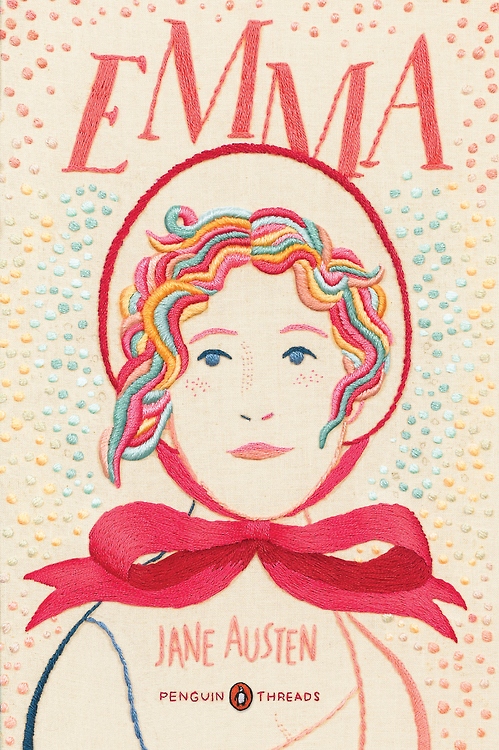
Jane Austen’s Emma

tumblr_mss4csHCJ21ssrt9xo1_500

I wish all books were this pretty!

Emma by Jane Austen
Published Dec 1815 by John Murray
Classic/Romance
Format: e-book; 456 pages
Also From This Author: Pride and Prejudice, Sense and Sensibility, Northanger Abbey, Mansfield Park, Persuasion
Goodreads | Amazon
My Rating: 4/5

This summer I was on a Jane Austen spree; I read Persuasion, Pride and Prejudice, Mansfield Park, and finally Emma. It was my first time reading it, although I was already familiar with the story because of the 1996 film version (featuring the worst period-era wig ever, courtesy of Ewan McGregor).

churchill

Seriously, he looks like the Mad Hatter.

But I never really liked Emma as a character. She’s snobby, meddlesome, and rather immature (like when she gets upset at not being able to decline an invitation because she wasn’t even invited…ugh). However, after finally reading the novel I actually came to *like* Emma, or maybe I just really liked Mr. Knightley ;) His speech near the end was so sweet, and I love this little excerpt afterwards:

He had ridden home through the rain; and had walked up directly after dinner, to see how this sweetest and best of all creatures, faultless in spite of all her faults, bore the discovery. (Chapter 49)

So there were great, swoon-worthy parts of the novel. But the worst, the worst part about Emma is the Box Hill picnic, when Emma maliciously makes fun of Miss Bates in front of all their friends. Because I had already seen the 1996 movie before reading the novel, I was dreading, absolutely dreading that chapter the entire time. And while I was watching the movie again after finishing the novel, I even muted the TV for a good minute and a half during that one excruciating part. There are a handful of books that contain chapters which I dread reading that much, but at least we are able to truly see Emma’s repentant heart afterwards.

Jane Austen’s novels frequently convey the motif of misunderstandings, and Emma is stock-full of them. She misunderstands the attentions and actions of Mr. Elton, Mr. Frank Churchill, and if that isn’t enough, Mr. Knightley as well. Clearly Emma does not possess an appropriate skill-set in order to be a successful matchmaker. Each of Emma’s misunderstandings add to the humor and drama of the plot, but they also help Emma to mature before the reader, and while I started the novel with the opinion of Emma being vain, selfish, and snobby, I ended it admiring Emma for her kind heartedness, compassion, and humility. There were two instances in which I loved Emma the most, the first being after Mr. Elton’s proposal, when Emma feels worse for her friend Harriet than she does for herself:

Every part of it brought pain and humiliation, of some sort or other; but, compared with the evil to Harriet, all was light; and she would gladly have submitted to feel yet more mistaken—more in error—more disgraced by mis-judgment, than she actually was, could the effects of her blunders have been confined to herself. (Chapter 16)

I absolutely admired her selflessness in this passage, and it added greatly to my sympathy for Emma in the second instance, near the end of the novel, when she suspects Mr. Knightley is about to confess his feelings for Harriet. At first Emma silences Mr. Knightley, but then, seeing how she has pained him, puts her duty as a friend over her own heartbreak, and pleads for Mr. Knightley to speak of anything he would like to. That must have taken immense courage.

I am very glad I gave Emma another chance. Even though I would not consider it my favorite Jane Austen novel, nor would I consider any of the characters my most favorite or least favorite, it was an enjoyable read with memorable themes and humorous indirect dialogue, without which I doubt I would have been able to laugh at or sympathize with our headstrong heroine.

Mansfield Park Part 3

Mansfield Park by Jane Austen
Published July 1814 by Thomas Egerton
Classic/Drama/Romance
Format: e-book; 502 pages
Also From This Author: Pride and Prejudice, Sense and Sensibility, Emma, Northanger Abbey, Persuasion
Goodreads | Amazon
My Rating: 4/5

Here is the last group of questions from the Mansfield Park read-along that I have been participating in. I mentioned this in my previous post, but I loved the novel and really connected with Fanny Price (shocking, I know). I completely understand if no one understands my reasoning, but I’m glad I enjoyed it so much; I would hate to dislike an Austen novel.

Mansfield Park Discussion Questions (Chapters 32-48)

  • Please, please discuss the entire Henry Crawford fiasco. Anything that you most want to discuss – his falling for Fanny, his proposal and her refusal, the reactions of those around them, etc. Consider also: Fanny in Portsmouth, Henry in Portsmouth, and Fanny’s steadfast refusal, and the return to Mansfield. Lots to discuss with this one! Wow. I felt so awkward and sympathetic for Henry. A big part of me wanted Fanny to give him a chance!! He starts off as a much more interesting character than Edmund, but later on he started getting creepy…especially when he just showed up in Portsmouth. Awk-ward. And also that one scene at Mansfield Park when he keeps badgering Fanny to tell him what she was thinking: I wanted to shout “Back off, man!” Seriously, some men cannot take a hint.
  • Perhaps one of the biggest points of contention for readers of Mansfield Park is the Crawfords. Though Fanny may look like a prig beside them, they are the only ones throughout the novel to truly appreciate her and praise her. Do you feel their esteem is genuine? Why do you think no one else appreciates Fanny for most of the story? And do you think the esteem which some characters show her in the end will last? I disagree that the Crawfords are the only ones who appreciate Fanny. I do believe that Edmund appreciates and praises her, too. And you can tell by the end of the novel that her aunt and uncle Bertram have grown to appreciate her as well. That being said, I do not believe the Crawford’s esteem is genuine because it is not reflected in their actions. After Mary moves away she hardly writes Fanny (not that Fanny is upset by that), and this describes an “out of sight, out of mind” attitude. Plus, Mary’s motive for spending time with Fanny is usually so that she can talk about or garner information about Edmund. Not exactly genuine. Henry, on the other hand, seems more sincere for the most part. He fails in his lack of humility. He does not let his actions speak for himself. If you compare him with Austen’s other heroes, for example Mr. Darcy, Colonel Brandon, and Captain Wentworth*, we see that they act behind the scenes and it is not until later that the corresponding heroines discover their true and praise-worthy characters. Perhaps if Henry had done something truly selfless and it was revealed to Fanny through a person other than himself, then maybe she would have considered his esteem as genuine (and maybe even considered him as a suitor).
  • Mansfield Park as a story wouldn’t exist without the actions and marriages of the original three sisters (now Lady Bertram, Mrs Norris and Mrs Price, respectively); each are very different in character, and each have made very different matches, setting the tone for everything that follows. What do you think of these three women and who they’ve become? Do you see any similarities between them – a free-spirit who marries imprudently, an emotionally-stoic, proper woman who marries very well, and a bitter, interfering curmudgeon who marries well enough – and other Austen characters? How do you imagine these three have changed over the course of their lives? And how did their story play out over the course of this book? I feel that Austen’s usual motifs of sense and reason are portrayed here as well. The only one of these sisters who ends off “well” would be Lady Bertram. Obviously she is not an ideal character; she is lazy and generally naive to what is going on around her. However, she is the only sister who undergoes a change during the course of the novel. By the end she has come to view Fanny as an actual family member, and even more, as her daughter. My optimism is determined to believe that the Bertrams (aside from Maria) all go on to have happy lives.
  • One of the things we’ve talked about quite a bit this Austen in August is the idea that Mansfield Park is much less a love story, less a story of romance, than people would generally have you believe. What do you think of this? Do you find it a solid romance, or do you think that’s merely a surface story, with a much deeper shadow story playing underneath? I absolutely agree that it is not a romance. If you are looking for a novel like Pride and Prejudice (which I happened to finish right before reading MP but thankfully I jumped into it already knowing what I was getting into), then you will be sorely and unfortunately disappointed. It is NOT a love story. In fact, the focus of the novel is not intended to be on Fanny and Edmund’s relationship whatsoever. I believe Austen uses this novel more than any other as a critique, and her opinions on life and society can clearly be traced through Fanny’s character development and the strong contrasts between Fanny and the other characters. I read that the psychological “Nature vs. Nurture” debate was active during Austen’s lifetime, and there are many instances in the book that reflect a pro-nurture attitude. There is even one point in the novel where I believe Edmund states that Mary would have turned out better had she been raised differently (“they continued to talk of Miss Crawford alone, and how she had attached him, and how delightful nature had made her, and how excellent she would have been, had she fallen into good hands earlier,” Chapter 47). And even though Fanny comes from a more “savage” gene pool, she is given a proper upbringing where she is denied luxuries and indulgences while her cousins are spoiled and never discouraged in their selfish indulgences. And in the end Fanny is proved to be the better mannered and more valued character while her cousins are ruined and scandalized. 
  • Now that we’ve read Mansfield Park in its entirety, are there any characters or aspects of the book that are generally disliked, which you’d like to defend? How do you feel about the respective marriages/pairings/endings for everyone? Is there anything you’d change, if you could? I really wish that Julia had not eloped with Mr. Yates. I wish she would have been more sensible in that regard. I would have liked for her to have been redeemed from her original character at the start of the novel. But other than that, I loved the novel and how everything turned out, even Fanny ending up with Edmund. Sometimes love takes years to bloom. Fanny loved Edmund since she practically arrived at Mansfield Park, yet Edmund needed more time than that. This is what makes the novel realistic, because not every relationship is a fairy tale.
  • If you’ve read other Austen novels, how do you think Mansfield Park compares or contrasts to the rest of Austen’s work? (class mobility, likeability, class represented, tensions, etc. compatibility of romance, ending, etc.) I believe it is very similar to Austen’s other works, but perhaps it is “more strongly concentrated”. It cuts out the swoon-worthy romance and intensifies the themes and commentaries.
  • If you’ve seen any of the movie adaptations, what do you make of them? Mansfield Park adaptations are notorious for making massive changes, especially to the character of Fanny (to make her more “likable,” more feisty, to connect more with a modern audience); do you think this is necessary? Does making Fanny more “feisty” lessen the impact of the story? I have only seen the 2007 adaptation, which I did enjoy despite the changes. I mentioned in my last post how the trailer from the 1999 adaptation describes Fanny as “spirited”. That poor-description has turned me off from even giving that adaptation a chance.
  • Is there anything else you’d like to discuss from Volume Three, or the novel as a whole? Yes! A couple of things. Firstly, I appreciated how the ongoing references to the play reminded the reader that many of the characters are acting. Unfortunately for Edmund, Mr. Rushworth, and Maria, they are respectfully deceived by Mary Crawford, Maria, and Henry Crawford. Fanny is cleverly able to see through Henry’s disguise, and she keeps control of her feelings so as not to fall victim to his flirtatious nature. Secondly, I loved how Jane Austen wrote the last chapter from her own point-of-view. It gave me shivers to hear her say “my Fanny”. I felt very connected to Austen during that last chapter, almost as if I was listening to her read the book aloud.

*to clarify, I mean Mr. Darcy’s dealings with Mr. Wickham, Colonel Brandon’s with John Willoughby, and Captain Wentworth’s secretive affections towards Anne (when he asks his sister and brother-in-law to drive her home and also when he has that message delivered to her just after Louisa’s accident. That showed a consideration for her being kept in the loop).