The Merry Adventures of Robin Hood by Howard Pyle

RobinHood

You who so plod amid serious things that you feel it shame to give yourself up even for a few short moments to mirth and joyousness in the land of Fancy; you who think that life hath not to do with innocent laughter that can harm no one; these pages are not for you.

The Merry Adventures of Robin Hood by Howard Pyle
Published 1883 by Scribner’s
Classic/Adventure
Format: print; 376 pages
Also From This Author: The Story of King Arthur and His Knights, Men of Iron, Otto of the Silver Hand
Goodreads | Amazon
My Rating: 5/5

Synopsis

He stole from the rich and gave to the poor, and in so doing became an undying symbol of virtue. But most important, Robin Hood and his band of Merry Men offer young readers more than enough adventure and thrills to keep them turning the pages. Who could resist the arrows flying, danger lurking, and medieval intrigue?

Thoughts

Quoth Robin Hood, snuffing the air, “Here is a fair day, Little John, and one that we can ill waste in idleness.”

If you know me well you know that I am in love with Robin Hood (like, if he showed up on my doorstep I would run away to Sherwood Forest with him in a heartbeat). I’ve been intrigued by the legend of Robin Hood since I first saw Disney’s animated Robin Hood (1973), which is also why the fox is my favorite animal (though I have a fondness for roosters, too).

So why is it that I have waited so long to read Howard Pyle’s The Merry Adventures of Robin Hood?! It’s probably for the best though, since I don’t think I would have understood much of the Old English language if I read this as a kid.

My favorite part of Pyle’s classic is of course the characters. Besides Robin, I also really loved the stories of Will Scarlet and Sir Richard of the Lea. Little John is as lovable as ever. Pyle perfectly describes him as a “great, faithful dog,” when it comes to his relationship with Robin. I found myself smiling at how effortless it was for other characters to pledge their honor to Robin. Each adventure followed a similar pattern: Robin would encounter someone who was on a quest or who needed help, he’d lend them a hand (or money, or his men), and at the end of the day all would be set right and Robin would have a new friend.

Robin Hood himself is so charming and hopeful that even the most destitute characters he comes in contact with can’t help but be infected by his infectious personality:

The Knight shook his head with a faint smile, but for all that Robin’s words made him more blithe of heart, for in truth hope, be it ever so faint, bringeth a gleam into darkness, like a little rushlight that costeth but a groat.

Read This Book If…:

…there is at least one adventurous bone in your body
…you love reading about legendary characters
…you enjoy a book that can make you laugh, gasp, and cry
…you’re into historical fiction

Final Musings

This book is not a fast read, but it is an exciting one! Each of Robin Hood’s adventures left me surprised, and even though I knew he would find a way to escape unscathed, I still found myself caught up in the suspense and action. For someone who was already enamored by Robin Hood, finally getting to read about his adventures only made me love him more!

“So my aching heart seeks thine, love
There to find its rest and peace,
For, though loving, bliss is mine, love,
And my many troubles cease.”

BONUS! Check back tomorrow for my (very late) post about a Robin Hood musical I saw earlier this year!

“Come Away, Come Away!”: J.M. Barrie’s Peter Pan

Peter-Pan-To-Neverland1

Artwork by Nicholas Jackson

“You just think of lovely wonderful thoughts,” Peter explained, “and they lift you up in the air.”


“After the first production I had to add something to the play at the request of the parents…about no one being able to fly until the fairy dust had been blown on him; so many children having gone home and tried it from their beds and needed surgical attention.” – J.M. Barrie

Peter Pan (originally Peter and Wendy) by J.M. Barrie
Published Oct. 11, 1911 by Hodder & Stoughton
Children’s/Young Adult Fantasy
Format: Annotated hardcover; 182 pages
Also By This Author: The Little White Bird, Peter Pan (play), The Admirable Crichton
Goodreads | Amazon
Rating: 5/5

Synopsis:

Peter Pan, the book based on J.M. Barrie’s famous play, is filled with unforgettable characters: Peter Pan, the boy who would not grow up; the fairy, Tinker Bell; the evil pirate, Captain Hook; and the three children–Wendy, John, and Michael–who fly off with Peter Pan to Neverland, where they meet Indians and pirates and a crocodile that ticks. 

(This review is spoiler free)

Thoughts:

What is there left to be said about the story of Peter Pan, the Darling children, and Neverland? I feel as if this beautiful story about children who don’t want to grow up has been analyzed, digested, and adapted more times than anyone can count, but clearly there is a reason for that: Peter Pan is an enduring masterpiece. So instead of analyzing it, I just want to share a few of the things that struck me the most while reading this book.

Firstly, I checked out my library’s copy of The Annotated Peter Pan, and I’m really tempted to buy a copy for myself. It has so much information about J.M. Barrie, the early productions of the play, hundreds of footnotes (which is where I found that quote from Barrie about the fairy dust), and some chapters on Peter Pan adaptations, spin-offs, and productions.

The Introduction by Editor Maria Tatar included this similarity between Peter Pan, The Wizard of Oz, and The Adventures of Huckleberry Finn, which echoed my own feelings while reading the novel:

[Dorothy], Huck, and Peter have won us over with their love of adventure, their streaks of poetry, their wide-eyed and wise innocence, and their deep appreciation of what it means to be alive. They all refuse to grow up and tarnish their sense of wonder and openness to new experiences.

Reading this book as an adult, I noticed myself trying to rationalize things or figure out a logical solution to the characters’ conflicts, but when I tried to see Peter Pan and the world of Neverland through the eyes of the Darling children, I began to feel inspired and light-hearted again. This is the exact reason why I enjoy reading children’s and YA literature. Of course every genre deals with serious subject matter, I am not disputing that, but I particularly love reading tales from the POV of a child or adolescent; experiencing situations from the eyes of a younger person has always been eye-opening to me.

Another aspect of the novel that made a big impression on me was Barrie’s style of writing. His sense of humor is both subtle and cheeky, and it’s most concentrated in his descriptions of the characters. One of my favorite examples of this is from a passage about Peter Pan’s imagination:

The difference between him and the other boys at such a time was that they knew it was make-believe, while to him make-believe and true were exactly the same thing. This sometimes troubled them, as when they had to make-believe that they had had their dinners.

And another one about Captain Hook being temporarily overcome by softness:

There was a break in his voice, as if for a moment he recalled innocent days when–but he brushed away his weakness with his hook.

Speaking of the characters, every film adaptation I have seen of Peter Pan has done an excellent job at keeping the characters pure to their original depictions. I grew up watching both Hook and Disney’s animated version of Peter Pan, and I was easily able to resonate each of the film characters with their print versions. Captain Hook seemed both hauntingly intimidating and ironically frightful while Tinkerbell was as mischievous as ever.

I loved how the last chapter concluded everything nicely for our characters, although in such a short and intense way that it definitely brought tears to my eyes. This is one of those books that stays with you a while after you finish the last page; you’ll reflect on things in a bittersweet or inspirational way.

Read This Book If…:

…you have an active imagination
…you’re always up for an adventure!
…you’re not ready to grow up (or you have grown up, and you wish you hadn’t)
…you need to refresh your sense of wonder and embrace the unexpected

Final Musings:

I dearly loved this book, in a different way than I probably would have if I had read it as a child. The themes that resonated with me the most weren’t about the pirates or the fairies, but about living for the moment, staying curious and interested, and always being ready to face the unexpected (as impossible as that sounds). And this wonderful story reminded me that sometimes we have to pause and take a look at the things around us, to reflect on where we are and how we got there.

Odd things happen to all of us on our way through life without our noticing for a time that they have happened.

To Kill a Mockingbird & Childhood Innocence

tokillamockingbird

The sixth grade seemed to please him from the beginning: he went through a brief Egyptian Period that baffled me – he tried to walk flat a great deal, sticking one arm in front of him and one in back of him, putting one foot behind the other. He declared Egyptians walked that way; I said if they did I didn’t see how they got anything done, but Jem said they accomplished more than the Americans ever did, they invented toilet paper and perpetual embalming, and asked where would we be today if they hadn’t? Atticus told me to delete the adjectives and I’d have the facts.

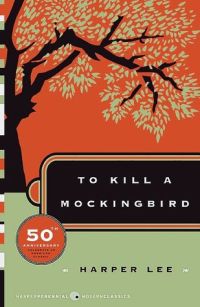
To Kill A Mockingbird by Harper Lee
Published July 1960 by J.B. Lippincott & Co.
Classic/Young Adult
Format: Paperback-324 pages
Goodreads | Amazon
My Rating: 5/5

One of my favorite parts about this novel was that it’s told from the point of view of a 6-year-old girl, so every now and then we get to enjoy hilarious commentaries like this one about the Egyptians. Scout’s childhood perspective serves more than to amuse us, however. Her innocence and unprejudiced outlook on life brings us emotional conviction, but one that inspires hope in us instead of guilt or regret. To Kill a Mockingbird takes place shortly before the peak of the Civil Rights Movement, so there is a great deal of racial tension going on that is presented through the eyes of a child, which is genius, in my opinion. I loved that Harper Lee did that; having Scout narrate her observations was a powerful way of highlighting not only the injustice in racism, but the injustice in all prejudices. I think one of my favorite scenes in this novel happened during the big court case, when Scout and Dill stepped outside for a moment  and ended up having a conversation with Mr. Raymond, “the town drunk”. Mr. Raymond is known for stumbling around town nursing a brown paper bag-covered bottle. When Dill comes out of the courthouse with an upset stomach, Mr. Raymond offers him a sip of his drink to help him feel better, and this is when we find out that all Mr. Raymond has been drinking is Coca-Cola. The reason? Because the townspeople don’t agree with Mr. Raymond’s lifestyle (he has “mixed” children), so he feels the need to give them a reason for his actions–or something they can blame them on.

I had never encountered a being who deliberately perpetrated fraud against himself. But why had he entrusted us with his deepest secret? I asked him why. “Because you’re children and you can understand it…”

I love this statement that children can understand what adults are often blinded from. They haven’t been as tainted by prejudices like adults have been. And in Scout’s case, this can be attributed to her moral upbringing by her father, Atticus. Let me just say that Atticus is my favorite fictional parent ever–I inspire to be like him when I’m a parent one day. He shows how important moral education is for children, and I believe the book argues that moral education is the responsibility of the parent, and not the responsibility of teachers or even extended family members. Whenever Scout and Jem have questions, Atticus answers them, and he answers them in a way that his children can understand. Whenever they have faulty opinions, Atticus realigns them, and he does it in a way that doesn’t belittle his children. He takes his role as a father very seriously and he always leads by example. This theme of childhood innocence in To Kill a Mockingbird was incredibly powerful to me as a reader. I mentioned at the beginning that Scout’s narration produced this inspiring emotional conviction in me, and I don’t think I would have been as impacted by this novel if it had been written from any other POV, even if Jem had been the narrator. I loved Jem, he was a great older brother, but he was already a little too grown up to be the most effective narrator. But, he and Scout both gave me plenty of chuckles from quotes like the one I’m about to end this post with:

As I made my way home, I thought Jem and I would get grown but there wasn’t much else left for us to learn, except possibly algebra.

Clearly there are countless of things to be said about To Kill a Mockingbird, but what were the ones that stood out to you the most?

Little Women: Discovering a Childhood Classic in Adulthood

littlewomenLittle Women by Louisa May Alcott
Published 1868 by Roberts Brothers
Classic/Young Adult
Format: e-book; 560 pages
Also From This Author: Little MenJo’s Boys
Goodreads | Amazon
My Rating: 5/5

I have seriously been slacking on my book reviews. I finished Little Women weeks ago and I’m finally forcing myself to type out my thoughts. But rest assured, I loved every minute of this book.

I am still surprised at myself for not having read this book when I was a child, especially because it is right up my alley. Little Women is the type of book that makes me want to have daughters one day, so we can read it together and gush over our favorite moments.  Although I felt oddly guilty at the fact that I didn’t read this book sooner, I did already know the story because I grew up watching the 1994 film version with Winona Rider and Christian Bale. Ilittlewomenmovie still really love this movie, but I am so glad I finally read the novel because it helped redeem some characters and plot lines for me, specifically Amy March, who I had always regarded as the bratty younger sister who just never matures. But she does mature! The movie just doesn’t elaborate on it. So, moral is: always read the book! Even if you read it afterwards :)

My absolute favorite part of this novel was the relationship between the March sisters. They seemed so real despite the fact that they were ideal relationships. They laughed together, cried together; they fought and they made up; they made sacrifices for each other and they took care of one another. You could see so much love that it really encourages you to love your own family a bit more. So many times during this novel I wished I could have hugged my siblings!

Another aspect of this book that really made an impression on me was the role of Marmee. She’s more than just a mother; she’s also a friend to the March sisters and she’s their guide in every area of life. I loved how much wisdom she showed to the girls, wisdom that I definitely benefited from myself. One of my favorite scenes of Little Women is when Marmee gave Meg some advice about nurturing and caring for her new marriage:

“Guard against the little piques, misunderstandings, and hasty words that often pave the way for bitter sorrow and regret.”

I probably related the most to Meg, the eldest sister and the one who first realized that what she needed in life was not what she had always wanted:

She had not yet learned to know how rich she was in the blessings which alone can make life happy.

I loved the gentleness of Beth, always caring and unselfish. She seems like the least developed of the March sisters, but really she holds them all together:

There are many Beths in the world, shy and quiet, sitting in corners till needed, and living for others so cheerfully that no one sees the sacrifices till the little cricket on the hearth stops chirping, and the sweet, sunshiny presence vanishes, leaving silence and shadow behind.

Amy, Amy, Amy… Like I said before, I used to get extremely aggravated by her brattiness because that’s mostly what the 1994 film version portrayed. But she’s just a typical baby sister who still has to grow out of her selfishness and immaturity, just like we all (hopefully) do. We see less of these traits in Meg, Jo, and Beth because they are already relatively grown up when the novel starts. However, I do love the later chapters that focus on Amy’s growing up because we get to see things from her POV and it’s in those chapters that I realized how much Amy does care about those around her. And for those of you who still ship Jo and Laurie, let me just say that Louisa May Alcott got it right. Amy is by far the much better match for Laurie, and it’s because of her that he finally stopped being lazy and mopey. And this quote from Amy regarding marrying Laurie is what really redeemed her character for me:

“How delightful it is to be able to help others, isn’t it? That was always one of my dreams, to have the power of giving freely, and thanks to you, the dream has come true.”

And of course there’s our heroine, Jo, who helps us all realize that we can attain our dreams with lots of hope and hard work, and who, like me, forgets and remembers this beautiful thought:

“I do think that families are the most beautiful things in all the world!”

littlewomenmovie2Little Women (1994)

I have always loved this movie! I used to watch it with googly eyes when I was younger (I don’t have googly eyes now, of course…). It’s one of those movies I could watch every day and that has those heart-touching scenes that never fail to make me cry (like when Beth gets her piano! Bravo Claire Danes on bringing out the tears from me). And although I am probably one of the few consistent shippers of Jo and Professor Bhaer, I have always loved them together. That scene at the end is one of my favorites :)

Pros: the acting! All of the locations and costumes, staying relatively true to the original story.

Cons: cutting out some of my favorite character developments (but it’s understandable), like Amy’s maturity and the early relationship between Meg and Mr. Brooke (which I really gushed over in the book).

For those of you who have read (or watched) Little Women, what were some of your favorite moments? How do you feel about Amy and  the “love square” between her, Jo, Laurie, and Professor Bhaer?

Shakespeare in the Spring: Much Ado About Nothing

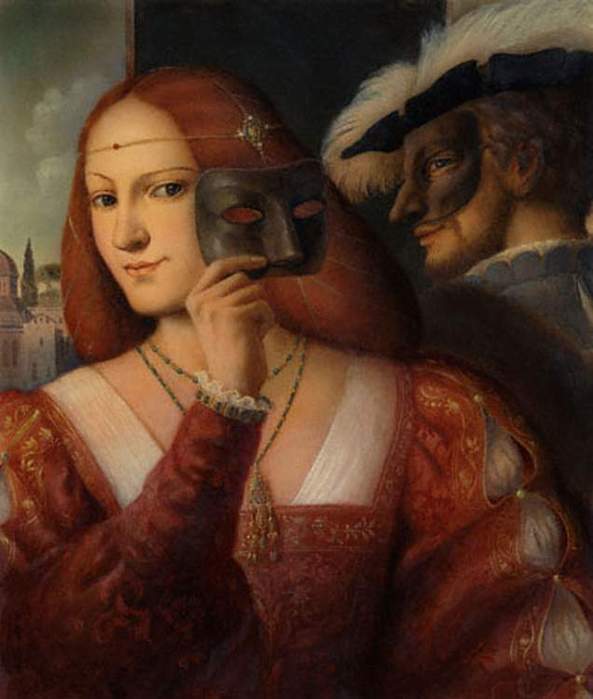
07. Craft, Kinuko Y. - Much Ado About NothingMuch Ado About Nothing by William Shakespeare
First Performed in 1599
Classic/Play
Format: e-book; 116 pages
Also From This Author: Romeo and JulietHamletMacbeth
Goodreads | Amazon
My Rating: 5/5

Firstly, Happy Birthday William Shakespeare! I’m a few hours late but not by U.S. time ;)

I thought an appropriate way to celebrate would be to gush about how much I enjoyed Much Ado About Nothing, which I read for the first time last week :) After reading and posting about Macbeth, it was nice to dive into something much more light-hearted and uplifting.

Like several of Shakespeare’s comedies, Much Ado follows the trials and tribulations of two couples; Claudio and Hero, the sweet-tempered ones, and Benedick and Beatrice, the witty ones who always seem to be at odds with each other. Although there is one main conflict that seemed rather malicious, we automatically know that since it’s a comedy, we have no need to fear any worse case scenarios. Spoiler alert: there’s a happy ending.

The things I enjoyed the most about this play were Shakespeare’s quippy one-liners, of course, but also the characters, who very much reveled in teasing and playfully tricking one another. One of my favorite scenes was Act II Scene III, when Don Pedro, Claudio, and Leonato, knowing that Benedick is hiding nearby, create this elaborate lie that Beatrice is in love with him. Immediately afterwards, Hero, Margaret, and Ursula discuss the same lie while Beatrice is eavesdropping, and by the middle of the third act, our two witty rivals are smitten.

“Therefore let Benedick, like covered fire,
Consume away in sighs, waste inwardly.
It were a better death than die with mocks,
Which is as bad as die with tickling.” Hero, Act III scene I
( I just loved the death by tickling line!)

There were several smile-inducing moments for me in Much Ado About Nothing. I’m a sucker for those Pride and Prejudice type romances, and I couldn’t find any flaws in Benedick and Beatrice as their relationship went from bitter rivals to loyal lovers. In other Shakespearean comedies, I feel that the romantic relationships are shallow; Benedick and Beatrice’s love felt much more plausible and long-lasting to me.

muchadofilmJoss Whedon’s Much Ado About Nothing (2012)

I had been eagerly wanting to watch this recent film adaptation by Joss Whedon since it’s release in 2012, but of course I wanted to actually read the play first. The film itself is word-for-word Shakespearean dialogue so if you haven’t read Much Ado or you aren’t very familiar with the Shakespearean tongue, you may have some difficulties in following along. BUT, many of the actors do a phenomenal job of reeling you in, even if you don’t know what the heck is going on.

For starters, Nathan Fillion (from Firefly and Castle), plays the moronic Dogberry (essentially a detective/sheriff who thinks too highly of himself despite the fact that half the time he doesn’t even know what he’s saying) and he had me laughing out loud so often, especially during this little coat mix-up scene:

dogberrygif

Love the T-Rex arm!

He did a great job at portraying the pure ridiculousness of his character.

Another scene that really moved me was the almost-wedding scene, when Claudio outs Hero in front of all the guests as being unfaithful. All of the actors were very convincing, and I felt more saddened by that scene after watching the film than I had from simply reading the play.

Also, after finishing the movie I began listening to this song from the soundtrack on loop. The lyrics are all Shakespeare, but the tune is catchy and fun to sing along to :)

I haven’t seen Kenneth Branagh’s 1993 version of Much Ado About Nothing, but it is on my to be watched list. It features Emma Thompson so I have no doubt that I’ll enjoy it.

There you have it! Hope this post encouraged you to read Much Ado About Nothing! And if you have already read it, what did you most enjoy?

Shakespeare in the Spring: Macbeth

macbethMacbeth by William Shakespeare
First Performed in April 1611
Classic/Play
Format: e-book; 132 pages
Also From This Author: Romeo and JulietHamletMuch Ado About Nothing
Goodreads | Amazon
My Rating: 3/5

If I could have, I would have avoided making my first “Shakespeare in the Spring” post about Macbeth, but I read it back in October (it’s perfect Halloween reading) and I never got around to writing my post about it.

So, why the avoidance?

I adore Shakespeare. I love quoting him, I love watching film adaptations of his plays, and I love talking about his works with bookworms and non-bookworms alike. However, there is one thing about Shakespeare that I don’t like: I do not like his Scottish Play, Macbeth.

Shakespeare’s tragedies are my favorites. In 8th grade we read both As You Like It and Hamlet. I did like As You Like It (we even took a field trip to see the play–my first!), but when we started Hamlet I fell in love. It had everything a “wanna-be gothic” pre-teenage girl could want to read (yes, embarrassingly enough, that is how I classify that epoque of my life). And since then, I have greatly admired Shakespeare’s tragedies. I love reading them and experiencing them all over again, except for Macbeth.

I’ve read Macbeth twice now and both times I’ve been unhappy about it. It’s not because of Shakespeare’s writing (his words and themes I actually did like), but I think it’s because of Macbeth and even more so, Lady Macbeth. Let me compare these two characters to another Shakespearean tragic hero: Hamlet. Despite the indecisive masochistic behavior of Hamlet, I still root for him. Even though his identity as a tragic hero means he’s doomed, I still want good things for him. I cannot say the same for Macbeth and his wife. I really wanted them to die the whole time. Well, maybe not Macbeth, but definitely his wife.

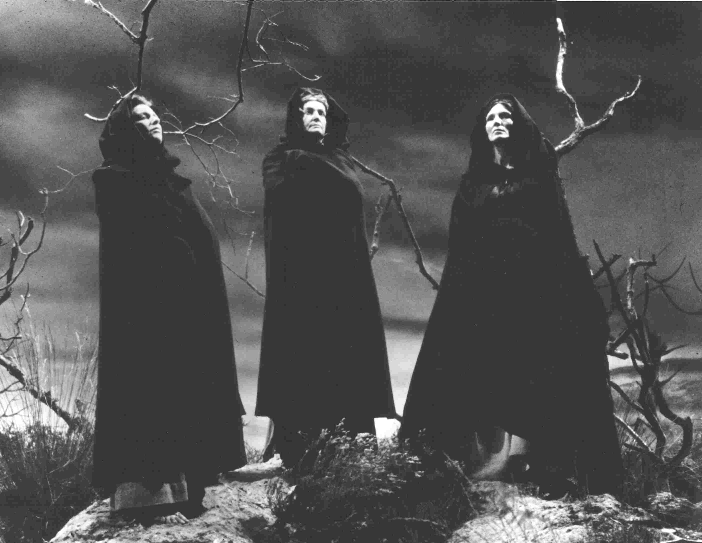
It’s wonderful that Shakespeare created such a strong and dominate female lead. I really did appreciate that she broke the model for a traditional female character. She was actually more of a male figure than Macbeth: she’s strong-willed, ambitious, and violent. However, I really viewed Lady Macbeth as more of a disease; after Macbeth hears from the weird sisters that he will be king, his wife immediately begins feeding him poisonous thoughts about power and it is she who provides Macbeth with the plot to kill King Duncan. Macbeth is barely able to summon enough “courage” (if you can call it courageous to kill your friend and king) to commit the murder, and it is Lady Macbeth who guiltlessly adds the finishing touches needed to successfully frame two of the king’s men.

This murder and great conflict occurs early on in the play in Act II, and in the remaining three acts we witness how the deepening guilt destroys Macbeth and his wife. For those who have read Macbeth, you know there are plenty of memorable themes going on. Obviously, don’t murder someone in order to take their place! The guilt will literally be the end of you. Hamlet taught that to us as well. I think my favorite theme from Macbeth, however, was that not everything is as it seems, or as Macbeth so eloquently puts it, “fair is foul, foul is fair.” What seems like a fortuitous future may actually bring us nothing but regret and guilt, our friends could end up being our enemies, and even those characters who would appear angelic and hospitable (such as Lady Macbeth) could actually be the most ruthless of them all.

I know that Macbeth  is one of Shakespeare’s most admired plays, and I understand why, but I have a question for those of you who love it: what do you find most enjoyable about it? Like I said, I’ve read it twice already and I don’t anticipate ever reading it again, but if anyone wants to take on the challenge of changing my mind about it, please try!

Northanger Abbey & Being Catherine Morland

Northanger Abbey

Yes, Catherine. The middle of the night is definitely the perfect time to inspect some creepy old cabinet.

Northanger Abbey by Jane Austen
Published Dec 1817 by John Murray
Classic/Romance/Suspense
Format: e-book; 170 pages
Also From This Author: Pride and Prejudice, Sense and Sensibility, Emma, Mansfield Park, Persuasion
Goodreads | Amazon
My Rating: 4/5

I was filled with a bitter-sweet feeling after finishing Jane Austen’s Northanger Abbey last month; bitter because it was the last Austen novel I had yet to read and sweet because I finally found the Austen heroine I most resemble. Yes, I am Catherine Morland: young, adventurous, naive at times, and above all, impressively talented at scaring myself.

Earlier this year I read Shannon Hale’s novels Austenland and Midnight in Austenland. The first novel borrows extensively from Pride and Prejudice, but Midnight in Austenland is a partial re-imagining of Northanger Abbey, so of course that means I wanted to stay up until 2 A.M. reading it. This is the perfect hour to read gothic novels: the moon is high and bright in the sky, everyone else in my apartment complex is fast asleep, and it’s either eerily quiet outside or there’s that one pair of stray cats defending their territories somewhere far off.

For those of you unfamiliar with Northanger or Midnight in Austenland, without spoiling too much, both Catherine Morland and Charlotte Kinder convince themselves that a gruesome murder has been committed and then become obsessed with finding (mainly fabricating) evidence and motives. So, while reading Midnight in Austenland, I heard (or imagined) a noise somewhere in my apartment and immediately my heart started pounding. Of course this noise can’t be nothing, and although, unlike our gothic heroines, I didn’t immediately imagine a murder scene, I did use the flashlight on my phone to quickly scan my bedroom to make sure nothing was lurking about. And that is the moment I knew I was Catherine Morland (despite the fact that at that point I hadn’t even read Northanger Abbey yet).

Northanger Abbey was published posthumously, roughly four months after Austen’s death, but interestingly enough it was actually the first novel Austen completed. It has many similarities to Austen’s other novels, for example it is a coming-of-age tale that includes deceptive “gold-digger” type characters, exaggerates inappropriate behaviors, and discusses the relationship between love, marriage, and fortune. However, this novel reads a lot differently than Sense and Sensibility or Pride and Prejudice, which were Austen’s first two published novels. I felt that the characters were somewhat flat and didn’t possess complex personalities, but this was probably Austen’s design in wanting her novel to be more plot-driven. She’s very much criticizing gothic literature in her unique comical way, and if she knew how badly I spooked myself while reading Northanger Abbey, she’d probably smirk and shake her head at me.

Besides Catherine Morland, we also have the witty and always-amiable Mr. Henry Tilney who unintentionally provokes Catherine’s overactive imagination, as well as the persistently arrogant John Thorpe, who literally had me muttering my annoyances out loud. Well done Austen for making a character seem both flat and unbearably annoying at the same time.

Like I usually do after reading most classic novels, I watched the film adaptation to Northanger Abbey as well. Fun fact: Mr. Henry Tilney is played by JJ Field, who also plays the male lead in the film adaptation of Austenland. I think I preferred his light-hearted and teasing nature as Mr. Tilney, but maybe that’s just the Catherine in me speaking ;) Either way, I enjoyed both films, although Austenland is typically cheesy.

jjfield

Top: Northanger Abbey (2007) // Bottom: Austenland (2013)

Wuthering Heights Chapter XXVII-The End

Wuthering Heights by Emily Brontë
Published December 1847 by Thomas Cautley Newby
Classic/Romance
Format: Paperback; 308 pages
Also From This Author: Poems By Currer, Ellis, and Acton Bell
Goodreads | Amazon
My Rating: 3/5

Before I finally post my last, lingering thoughts on Wuthering Heights, I feel like I need to say something about my month-long absence from blogging. January was a rather tough month for us in many ways, and I think the stress finally took its toll on me both physically and emotionally, so I basically “checked out” in February. My life revolved around working, watching the Olympics (Go Team U.S.A.! Yes, I am a huge Olympics fanatic), reading, and focusing on my responsibilities here in Grenoble. Also, I have been sick three times this month (guess that’s a side-effect of working with children). BUT, I am back and even though I am forcing myself to write and publish this last Wuthering Heights post, I am ready to dive back into the blogosphere with some exciting posts (such as my thoughts on Northanger Abbey, which I currently have my nose in, as well as a fun challenge I am giving myself for my birthday next week!).

wutheringheightsSo, let’s discuss how I felt about Wuthering Heights the second time around! But first, here are links to my previous posts:

Chapters I-IX
Chapters X-XVII
Chapters XVIII-XXVI

[Spoilers ahead, beware!]

This section starts off with one of the most suspenseful sections in the novel. Cathy, in her naivety and gentleness, is lured by Linton to Wuthering Heights, where Heathcliff essentially takes her prisoner. His intentions are obvious to the reader: he wants Cathy and Linton to become married. The worst part about this section is not the forced marriage, but the fact that Edgar Linton is on his deathbed and Cathy is afraid she will be unable to see him before he dies since Heathcliff refuses to let her leave.

“Mr. Heathcliff, you are a cruel man, but you’re not a fiend; and you won’t, from mere malice, destroy, irrevocably, all my happiness.”

Oh he would, but fortunately that doesn’t happen. Catherine is reunited with her father just before he dies, and finally Heathcliff becomes the master of both Wuthering Heights and Thrushcross Grange. Shortly afterwards, Linton dies as well, which is a sad passage considering that Heathcliff’s neglect is mostly responsible. At this point Nelly’s narration ends as we have arrived at Mr. Lockwood’s arrival, and we dare to ask ourselves, “What’s next?” in Heathcliff’s schemes.

Mr. Lockwood now decides to leave Thrushcross Grange, and I honestly can’t blame him, but before he leaves he visits Wuthering Heights one last time and we can now reconcile the Heathcliff, Hareton, and Cathy that we met at the novel’s beginning with those of Nelly’s narration. We see how cruel Cathy has become towards her cousin Hareton, and even though I never stopped desiring a happy ending for Cathy, I did sympathize with Hareton a great deal. I felt that he and Linton were the two extremes of the same spectrum: both were abused and neglected by Heathcliff, both were unloved by their fathers, and both sought the attentions of young Cathy Linton, yet we find that Hareton had a much stronger spirit than Linton. I understand and sympathize with the fact that Linton was already a frail child before falling into Heathcliff’s clutches, where he was further abused and terrified, but the way he responds is not the same way that Hareton responds to his own sufferings. Linton, out of fear, does whatever his father asks of him, regardless of the consequences it has on others. Yet Hareton, who does obey Heathcliff for the most part, still has his own desires that ultimately control his destiny.

Now, for the long-awaited happy ending! After several months, Mr. Lockwood returns to Wuthering Heights where we find that Heathcliff has died (and is unsurprisingly mourned by no one). Yet, before he died, his behavior changed a great deal, and he let go of his desires to continue his revenge on Cathy and Hareton. We have Catherine Earnshaw Linton to thank for this: that morbid grave exhumation scene in Chapter 29 now seems to have a greater purpose than to further elaborate Heathcliff’s twistedness. The final chapters of the novel show a much pleasanter scene at Wuthering Heights: Cathy and Hareton, once at odds, are able to forgive and forget and move on (finally someone is able to!), and Nelly confesses to Mr. Lockwood that the two will soon be married (this even elicited a silent “aww” from me).

My second time reading this novel produced some interesting reactions. My hatred for Heathcliff and Catherine Earnshaw grew deeper, yet I was finally able to see an actual happy ending for two characters I ended up “rooting for” this time around. Honestly, I don’t think I will attempt to read this novel again for another 10 years, but I was glad to see that some people who were reading along with me actually enjoyed it! That is refreshing.

For those who have read Wuthering Heights, what were your final thoughts on the novel? Do you think it deserves to be canonized? What was the biggest take-away for you? (For me it was to forgive and forget! Honestly, all of that bitterness and thirst for revenge seemed so exhausting)

Alice in Wonderland: Am I the only one who…

cheshire-cat-10

“We’re all mad here.”

Alice’s Adventures in Wonderland and Through the Looking Glass by Lewis Carroll
Published Nov 1865/1871 by Macmillan
Classic/Young Adult
Format: e-book; 161 pages
Also From This Author: The Hunting of the Snark, Jabberwocky
Goodreads | Amazon
My Rating: 3/5

…did not enjoy this book? I have only ever heard good things about Lewis Carroll’s Alice’s Adventures in Wonderland and Through the Looking Glass (I read them both), but try as I might, I could not get into them. I’m familiar with the story, because I own and love both Disney movie versions, so I automatically assumed that I would love the novel as well. I was sadly disappointed.

Currently I am fighting a cold, so I don’t have the creative energy to eloquently pen all of my opinions on Alice and her…strange…dreams, so allow me to sum them all up in the ever reliable Pros and Cons format!

Alice’s Adventures in Wonderland and Through the Looking Glass:

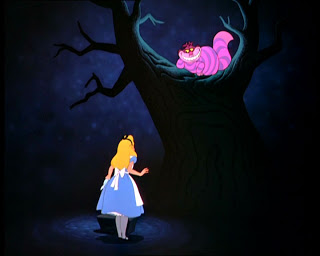
Pros: My favorite character, and perhaps the only one who never annoyed me, was the quizzical Cheshire Cat. I would have loved to see more appearances (and disappearances and reappearances) by him! I think the reason I loved him so much is because the Cheshire Cat is the most reasonable out of all the Wonderland creatures. The things he said actually did make sense.

Another character who amused me was of course the ever-popular Mad Hatter. Who doesn’t love him? I would have also appreciated more scenes with him, so I thank Tim Burton for fulfilling that desire in his 2010 film.

Fortunately, the live flowers weren’t quite as annoying in the novel as they are in the animated movie. Along with the little skit about the Walrus and the Carpenter, the live flowers bit is my least favorite scene in the movie.

Cons: Parts of this book honestly gave me a headache, mainly because it was really hard to follow. It’s like reading about a dream someone had after taking one too many Benadryl, which is actually probably why a lot of people like this story. I understand its uniqueness as a work of literature and I appreciate Carroll’s ability to break conventionality, but I have come to realize that books written in this type of nonsensical format are not my cup of tea. I might be inclined to put Alice on the same bookshelf as Coleridge’s Kubla Khan, although if I had to choose between the two of them, I’d much rather read Alice.

Another con was that so many of the characters drove me insane. Alice, for one…I could not connect or relate to her on any level. And the Red Queen was undoubtedly my least favorite (main) character, although that’s not surprising to me since she’s also my least favorite character in the animated movie as well (Helena Bonham Carter makes her more likeable in the live-action film, at least in my opinion). Why was she in the story so much?

Other characters I did not appreciate were the White Queen and the White Knight, whom I really did try to like! Mainly because I pitied his clumsiness.

Quotes:

Alice had got so much into the way of expecting nothing but out-of-the-way things to happen, that it seemed quite dull and stupid for life to go on in the common way. [Alice’s Adventures in Wonderland chapter 1]

  • Love this. Let’s all be always expecting the unexpected :)

“It’s rather curious, you know, this sort of life!” [Alice’s Adventures in Wonderland chapter 4]

  • There was a nice group of little quotes like this one that helped me like the novel in some ways.

Suddenly, a footman in livery came running out of the wood–(she considered him to be a footman because he was in livery: otherwise, judging by his face only, she would have called him a fish)… [Alice’s Adventures in Wonderland chapter 6]

  • There is no significance in this quote other than the fact that it literally made me laugh out loud.

“We’re all mad here. I’m mad. You’re mad.” [Alice’s Adventures in Wonderland, chapter 6]

  • Ain’t that the truth, Mr. Cheshire Cat.

“Where do you come from?” said the Red Queen. “And where are you going?” [Through the Looking Glass, chapter 2]

  • After reading this line, the lyrics to “Cotton-Eyed Joe” were stuck in my head for a while…thanks to a recent episode of The New Girl (sorry! I love when my worlds collide!)

Closing Thoughts:

I know that I may have been a bit all over the place with this post, but it’s about Alice in Wonderland so anything goes! Honestly, it wasn’t the worst book I have read (I rated it 3/5 stars on Goodreads), but it was a big disappointment for me. That’s what happens sometimes when you set your expectations high. I should have approached it like I did Jane Eyre, which I thought I would hate and now it’s one of my favorite novels.

Jane Eyre Chapters XXX-End

Jane Eyre by Charlotte Brontë
Published Oct 1847 by Smith, Elder, and Company
Classic/Romance
Format: e-book; 332 pages
Also From This Author: Villette
Goodreads | Amazon
My Rating: 5/5

It’s hard to believe that this is the last day of September, and with it comes my last Septemb-Eyre post! It has been so wonderful spending these past few weeks discussing Jane Eyre with a great group of different bloggers. I have generally felt as if I was a part of a digital book club! Not only have I found a “new” book that I adore, but I have also made some new friendships along the way. So, without further ado, here are my remaining opinions of Charlotte Brontë’s Jane Eyre →Spoiler alerts for anyone who has not read Jane Eyre in its entirety←

Let me start this post by stating that this is one of the happiest endings I have ever read in a novel before! Even though both Jane and Mr. Rochester have suffered immense tragedies and heartbreaks in their lifetimes, by the time Chapter 38 rolls around, our tortured lovers are finally, and forever, happy :) I believe a lot of that has to do with the way Jane finds happiness. She doesn’t chase after it, but rather, she lets her morals and her conscience guide her, and eventually happiness finds her, and it is better than if she had sought it out herself.

To further elaborate my point, I give to you my unofficial “Jane Eyre Spectrum of Human Intention”:

  • On the far left we have Mr. Rochester: bold and extravagant “bachelor” who appears to be guided nearly exclusively by his feelings and emotions. He tosses conventionalities and morals aside after his wife inevitably succumbs to her madness. In his lifetime he has had several mistresses and at lasts falls in love with his “equal and likeness” (I just loved those lines), Jane. Tragically, this love affair is doomed from the beginning, and when Mr. Rochester’s attempt to commit polygamy is revealed, Jane flees despite Mr. Rochester’s tempting propositions of turning her into his mistress.
  • On the far right we have St. John Rivers: religious fanatic who is guided completely by “reason, and not feeling” (Chapter 32). He denies himself a marriage of love in exchange for one solely based on duty and practicality, and he even tries to blackmail Jane into submitting to his beliefs as well. During the third act of the novel, St. John does behave in Christian-like ways (by taking Jane in, getting her back on her feet, and employing her), however, he also treats her with coldness and authoritativeness as opposed to brotherly love, all in a desire to mold her into the perfect missionary wife.
  • Finally, smack dab in the middle we find Jane Eyre herself, who morally does what is right but who also never sacrifices her heart. (Now, I know that Jane confesses to us readers that she has never known what it is to be moderate, but I believe in the case between strictly following reason vs. strictly following feelings, she falls in the middle.) Throughout the novel, Jane fluctuates between emotional outbursts and fleeing from fleshly temptations, however, she lives by this motto: We need to always choose the path of the morally right, no matter how difficult. She looks to God and not to man regarding matters of conscience, and thus she is abundantly blessed because of all that she has overcome.

Jane overcomes more obstacles, tragedies, sufferings than any other character in this novel. She is unwavering in her principles and morals, she is unwavering in her faith in God, and she is unwavering in her philosophy that all persons on earth are equals, despite differences in class, wealth, education, and other ranking systems. One of the themes that stuck out the most to me while reading Jane Eyre was actually quoted in a line by St. John: “He that overcometh shall inherit all things” (Chapter 35). I just love how beautifully this theme is woven throughout all of the occurrences in Jane’s life. Never once did she face something that was too difficult to overcome; never once was she beaten by temptation, failure, or injustice, and why was that? Because she was guided by moral purity, selflessness, forgiveness: Christian principles that Brontë comments on regularly throughout her novel.

Another religious idea that Brontë discusses in this book is foreign missions. Jane and St. John’s characters are very similar in the idea that they both have a desire to serve others. However, they differ greatly in their opinions of how best to serve others. St. John essentially tells Jane that by not marrying him, she cannot become a foreign missionary, and thus she is denying God the ability to work through her. In his eyes, Jane was disobeying God. However, Jane has skills that she had already been using to help those even less fortunate than herself, and by the end of the novel we see how she will be able to serve another soul in need. I believe that Brontë implies that foreign missions are not a bad thing, they are simply not for everyone, and also, by not becoming a foreign missionary, it does not mean that one is “unusable” by God. Every country has a need, and every person can serve others, whether they stay in their home country or they go to another country.

Back to Jane and the subject of equality: before leaving Thornfield, Jane was Mr. Rochester’s equal, though not in class, wealth, or even physical capability. When she returns to Mr. Rochester, she is an independent woman, with respectable family ties (family that actually claims Jane as their own), and she has the ability to serve as Mr. Rochester’s physical helper–this is something that can be viewed as Jane wanting some type of power over her husband, but I absolutely loved what Jane says during the concluding chapter:

“I hold myself supremely blest–blest beyond what language can express; because I am my husband’s life as fully as he is mine. No woman was ever nearer to her mate than I am: ever more absolutely bone of his bone and flesh of his flesh. I know no weariness of my Edward’s society: he knows none of mine, any more than we each do of the pulsation of the heart that beats in our separate bosoms; consequently, we are ever together. To be together is for us to be at once as free as in solitude, as gay as in company. We talk, I believe, all day long: to talk to each other is but a more animated and an audible thinking. All my confidence is bestowed on him, all his confidence is devoted to me; we are precisely suited in character–perfect concord is the result” (Chapter 38).

I have to admit that while reading the final two chapters I had a permanent grin stretched wide across my face and tears shining in my eyes. So many emotions were going on! This book had me in tears when Mr. Rochester was doubting Jane’s realness, as if he was only imagining that she had returned to him. And one of my favorite parts about this reunion scene is when we discover how worried Mr. Rochester was for Jane’s life after she fled. This is another redeemable quality we find in our tortured hero that is discovered late in the novel because of Brontë’s use of first-person narration. (side note: I feel like I have talked about POV so much with this novel, but honestly, I really do think first-person narration is my favorite. It creates mystery, suspense, and tension…novels are incredibly interesting when we are only privy to one character’s thoughts, feelings, and desires!)

I should not have left him thus, he said, without any means of making my way: I should have told him my intention. I should have confided in him: he would never have forced me to be his mistress. Violent as he had seemed in his despair, he, in truth, loved me far too well and too tenderly to constitute himself my tyrant: he would have given me half his fortune, without demanding so much as a kiss in return, rather than I should have flung myself friendless on the wide world (Chapter 37).

I absolutely loved so many parts of this last section, and in between the tears I was literally laughing out loud when Jane and Mr. Rochester returned to their old teasing ways. I’m sure I’m not alone in cracking up because of Mr. Rochester’s jealousy over St. John? I would quote the entire exchange between Jane and Mr. Rochester, when he is trying to uncover information about Jane’s cousin, only it is too long…but I was laughing to myself during that entire passage.

And then, it touched my heart when Mr. Rochester stopped to thank God for reuniting him and Jane:

“I thank my Maker, that, in the midst of judgment, he has remembered mercy. I humbly entreat my Redeemer to give me strength to lead henceforth a purer life than I have done hitherto!”

Like I said in the beginning of this post: Jane Eyre has one of the happiest endings in any book I have ever read! And finally, one thing I really loved most about this novel was how everything came together: every single incident in this novel needed to happen for all the ones succeeding it to happen, and I thought Charlotte Brontë did a wonderful job as an author to make that seem effortless.

Well, I actually finished reading this novel during the first week of our Septemb-Eyre read along, but I have still been doing Jane Eyre themed things this month, including watching 4 different adaptations! I will briefly sum up my opinion about each one, beginning in the order I watched them, which also happens to be reverse chronological order: →Spoilers for Jane Eyre movie adaptations for those who have not yet seen them←

Jane Eyre (2011)

JaneEyre2011

I had heard only negative things about this film before I actually watched it, but fortunately I finished the novel beforehand, and I think that really aided me in liking this film. I was able to fill in gaps because there were a lot of things missing, especially regarding characters’ qualities.

Pros: The acting was superb; the cinematography was beautiful; I loved the music; the script was well-written; I loved the way this film was edited–one of my favorite parts was when the Rivers ask Jane for her name and we hear John Reed creepily call out, “Jane Eyyrreee…” before it flashes back to Jane’s childhood.
Cons: Mr. Rochester seems controlling and possessive, his sarcasm is more dark than it is witty; Bertha is practically cut out of the story; they leave out the best parts about the ending! It feels like a happy ending, but not entirely.

JaneEyre2006

Jane Eyre BBC Miniseries (2006)

This was probably my favorite adaptation, mainly because Mr. Rochester was just like Mr. Rochester in the book. This miniseries was very true to the novel, and only a few things were cut out or changed, some better than others.

Pros: Rochester is wonderfully portrayed–he’s sarcastic and witty to the point I was laughing out loud several times during his scenes, especially when Jane makes him jealous at the end! (the scene pictured here); the costumes were BEAUTIFUL; I loved the way they adapted the gypsy scene.

Cons: They gave Jane amnesia after fleeing Thornfield?; the whole post-wedding scene was weird in general–Jane wasn’t as adamant about leaving. In that scene, she didn’t seem as strong as novel-Jane. And parts of that scene were cheesy…
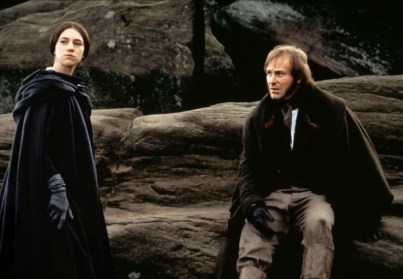
JaneEyre1996Jane Eyre (1996)

This was probably my least favorite adaptation out of the four that I watched. I don’t even remember much about it, to be honest, and I think that is because nothing really stood out, although there were some good parts.

Pros: I liked the actress playing Jane–she wasn’t an amazing actress or anything, but I did like her; I also liked the actress playing Mrs. Fairfax.

Cons: I did not like the portrayal of Mr. Rochester–although he was still proud and sarcastic, he seemed too nice at the same time; the ending was changed from the novel a little bit to my disliking.

Side-note: Amanda Root plays Miss Temple in this version, and she also plays Anne Elliot in my favorite adaptation of Persuasion; Sally Hawkins, who played Anne Elliot in the 2007 version of  Persuasion, portrays Mrs. Reed in the 2011 adaptation of Jane Eyre. Pretty cool :)

JaneEyre1983

Jane Eyre BBC Miniseries (1983)

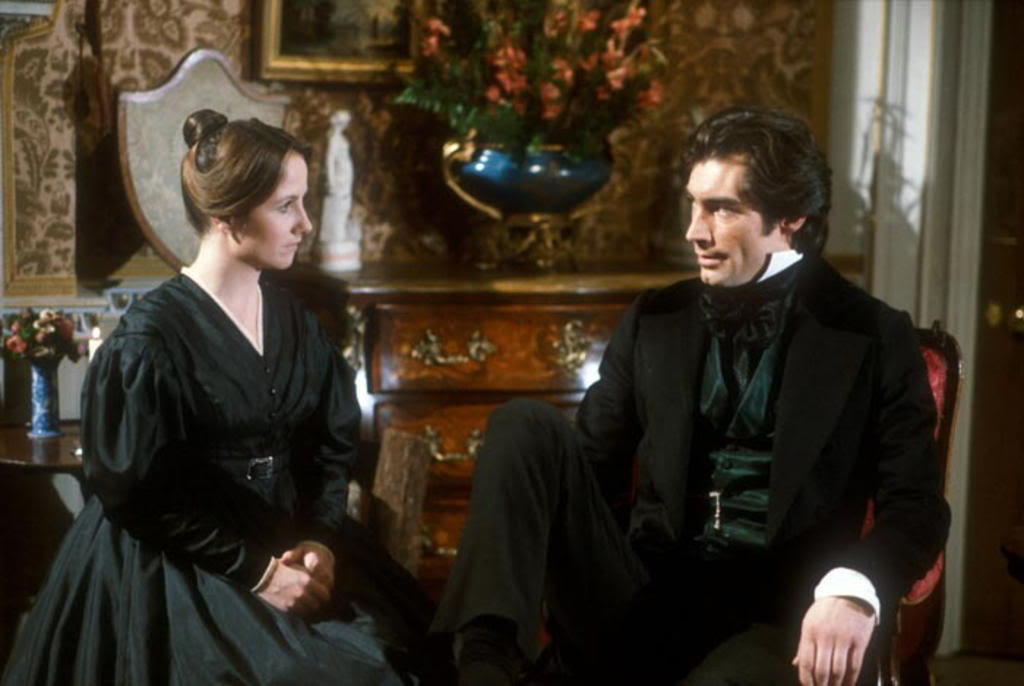
I loved this version, and it might have something to do with the fact that I have had a crush on Timothy Dalton since I was a little girl (I know…he’s like 70 years old now, but he was in an older version of Antony and Cleopatra that I watched at my grandma’s house one summer growing up and yeah…he’s pretty handsome).

Pros: Timothy Dalton is a fantastic actor–he’s does a wonderful job at portraying Mr. Rochester’s changeable behavior; this adaptation follows the novel very well, they even do the gypsy scene with Timothy Dalton dressed as an old lady! Finally!

Cons: like I said before, Timothy Dalton is handsome–too handsome to be Mr. Rochester; Jane’s character is missing some “Janeness” (she’s not as firm; also, some general film problems: the lighting is not good (lots of shadows), and the sound is off at times. Also, at Lowood they ring the bell for way too long, I was wanting to mute the volume!