
Shakespeare in the Spring: Much Ado About Nothing

07. Craft, Kinuko Y. - Much Ado About NothingMuch Ado About Nothing by William Shakespeare
First Performed in 1599
Classic/Play
Format: e-book; 116 pages
Also From This Author: Romeo and JulietHamletMacbeth
Goodreads | Amazon
My Rating: 5/5

Firstly, Happy Birthday William Shakespeare! I’m a few hours late but not by U.S. time ;)

I thought an appropriate way to celebrate would be to gush about how much I enjoyed Much Ado About Nothing, which I read for the first time last week :) After reading and posting about Macbeth, it was nice to dive into something much more light-hearted and uplifting.

Like several of Shakespeare’s comedies, Much Ado follows the trials and tribulations of two couples; Claudio and Hero, the sweet-tempered ones, and Benedick and Beatrice, the witty ones who always seem to be at odds with each other. Although there is one main conflict that seemed rather malicious, we automatically know that since it’s a comedy, we have no need to fear any worse case scenarios. Spoiler alert: there’s a happy ending.

The things I enjoyed the most about this play were Shakespeare’s quippy one-liners, of course, but also the characters, who very much reveled in teasing and playfully tricking one another. One of my favorite scenes was Act II Scene III, when Don Pedro, Claudio, and Leonato, knowing that Benedick is hiding nearby, create this elaborate lie that Beatrice is in love with him. Immediately afterwards, Hero, Margaret, and Ursula discuss the same lie while Beatrice is eavesdropping, and by the middle of the third act, our two witty rivals are smitten.

“Therefore let Benedick, like covered fire,
Consume away in sighs, waste inwardly.
It were a better death than die with mocks,
Which is as bad as die with tickling.” Hero, Act III scene I
( I just loved the death by tickling line!)

There were several smile-inducing moments for me in Much Ado About Nothing. I’m a sucker for those Pride and Prejudice type romances, and I couldn’t find any flaws in Benedick and Beatrice as their relationship went from bitter rivals to loyal lovers. In other Shakespearean comedies, I feel that the romantic relationships are shallow; Benedick and Beatrice’s love felt much more plausible and long-lasting to me.

muchadofilmJoss Whedon’s Much Ado About Nothing (2012)

I had been eagerly wanting to watch this recent film adaptation by Joss Whedon since it’s release in 2012, but of course I wanted to actually read the play first. The film itself is word-for-word Shakespearean dialogue so if you haven’t read Much Ado or you aren’t very familiar with the Shakespearean tongue, you may have some difficulties in following along. BUT, many of the actors do a phenomenal job of reeling you in, even if you don’t know what the heck is going on.

For starters, Nathan Fillion (from Firefly and Castle), plays the moronic Dogberry (essentially a detective/sheriff who thinks too highly of himself despite the fact that half the time he doesn’t even know what he’s saying) and he had me laughing out loud so often, especially during this little coat mix-up scene:

dogberrygif

Love the T-Rex arm!

He did a great job at portraying the pure ridiculousness of his character.

Another scene that really moved me was the almost-wedding scene, when Claudio outs Hero in front of all the guests as being unfaithful. All of the actors were very convincing, and I felt more saddened by that scene after watching the film than I had from simply reading the play.

Also, after finishing the movie I began listening to this song from the soundtrack on loop. The lyrics are all Shakespeare, but the tune is catchy and fun to sing along to :)

I haven’t seen Kenneth Branagh’s 1993 version of Much Ado About Nothing, but it is on my to be watched list. It features Emma Thompson so I have no doubt that I’ll enjoy it.

There you have it! Hope this post encouraged you to read Much Ado About Nothing! And if you have already read it, what did you most enjoy?
Shakespeare in the Spring: Macbeth

macbethMacbeth by William Shakespeare
First Performed in April 1611
Classic/Play
Format: e-book; 132 pages
Also From This Author: Romeo and JulietHamletMuch Ado About Nothing
Goodreads | Amazon
My Rating: 3/5

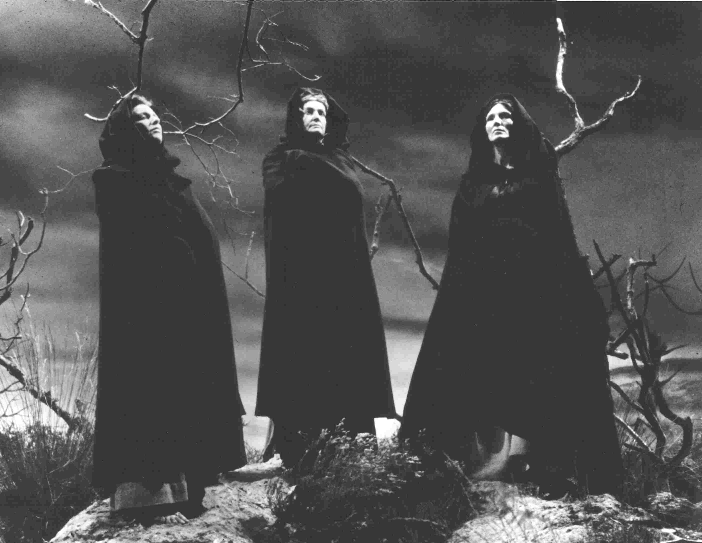
If I could have, I would have avoided making my first “Shakespeare in the Spring” post about Macbeth, but I read it back in October (it’s perfect Halloween reading) and I never got around to writing my post about it.

So, why the avoidance?

I adore Shakespeare. I love quoting him, I love watching film adaptations of his plays, and I love talking about his works with bookworms and non-bookworms alike. However, there is one thing about Shakespeare that I don’t like: I do not like his Scottish Play, Macbeth.

Shakespeare’s tragedies are my favorites. In 8th grade we read both As You Like It and Hamlet. I did like As You Like It (we even took a field trip to see the play–my first!), but when we started Hamlet I fell in love. It had everything a “wanna-be gothic” pre-teenage girl could want to read (yes, embarrassingly enough, that is how I classify that epoque of my life). And since then, I have greatly admired Shakespeare’s tragedies. I love reading them and experiencing them all over again, except for Macbeth.

I’ve read Macbeth twice now and both times I’ve been unhappy about it. It’s not because of Shakespeare’s writing (his words and themes I actually did like), but I think it’s because of Macbeth and even more so, Lady Macbeth. Let me compare these two characters to another Shakespearean tragic hero: Hamlet. Despite the indecisive masochistic behavior of Hamlet, I still root for him. Even though his identity as a tragic hero means he’s doomed, I still want good things for him. I cannot say the same for Macbeth and his wife. I really wanted them to die the whole time. Well, maybe not Macbeth, but definitely his wife.

It’s wonderful that Shakespeare created such a strong and dominate female lead. I really did appreciate that she broke the model for a traditional female character. She was actually more of a male figure than Macbeth: she’s strong-willed, ambitious, and violent. However, I really viewed Lady Macbeth as more of a disease; after Macbeth hears from the weird sisters that he will be king, his wife immediately begins feeding him poisonous thoughts about power and it is she who provides Macbeth with the plot to kill King Duncan. Macbeth is barely able to summon enough “courage” (if you can call it courageous to kill your friend and king) to commit the murder, and it is Lady Macbeth who guiltlessly adds the finishing touches needed to successfully frame two of the king’s men.

This murder and great conflict occurs early on in the play in Act II, and in the remaining three acts we witness how the deepening guilt destroys Macbeth and his wife. For those who have read Macbeth, you know there are plenty of memorable themes going on. Obviously, don’t murder someone in order to take their place! The guilt will literally be the end of you. Hamlet taught that to us as well. I think my favorite theme from Macbeth, however, was that not everything is as it seems, or as Macbeth so eloquently puts it, “fair is foul, foul is fair.” What seems like a fortuitous future may actually bring us nothing but regret and guilt, our friends could end up being our enemies, and even those characters who would appear angelic and hospitable (such as Lady Macbeth) could actually be the most ruthless of them all.

I know that Macbeth  is one of Shakespeare’s most admired plays, and I understand why, but I have a question for those of you who love it: what do you find most enjoyable about it? Like I said, I’ve read it twice already and I don’t anticipate ever reading it again, but if anyone wants to take on the challenge of changing my mind about it, please try!

Shakespeare in the Spring

20140406-145341.jpg

April is National Poetry month (at least in the U.S.) and I think it’s the perfect month for it. Spring has arrived; the flowers are blooming and the birds are perched in trees cheerfully chirping. This season is just asking to be spent reading romantic poetry in a park, isn’t it?

Another reason April is the perfect month to be called Poetry Month is because it is the presumed month in which William Shakespeare was born (April 23rd also marks the anniversary of his death). Shakespeare was the author of my absolute favorite play, Hamlet, and I believe I also have him to thank for sparking my interest in poetry to begin with (Byron helped as well). Therefore, to celebrate Poetry Month as well as the life of the world’s most influential writer, I have decided to spend the next four weeks reading and blogging about the three Shakespearean plays I have on my Classics Club List. I like to combine reading challenges and events so I can cross books off of my TBR list :)

So check back later this week for my thoughts on Macbeth, but for now, tell me: What is your favorite Shakespearean work (be it play or sonnet)?

Happy Sunday!

Northanger Abbey & Being Catherine Morland

Northanger Abbey

Yes, Catherine. The middle of the night is definitely the perfect time to inspect some creepy old cabinet.

Northanger Abbey by Jane Austen
Published Dec 1817 by John Murray
Classic/Romance/Suspense
Format: e-book; 170 pages
Also From This Author: Pride and Prejudice, Sense and Sensibility, Emma, Mansfield Park, Persuasion
Goodreads | Amazon
My Rating: 4/5

I was filled with a bitter-sweet feeling after finishing Jane Austen’s Northanger Abbey last month; bitter because it was the last Austen novel I had yet to read and sweet because I finally found the Austen heroine I most resemble. Yes, I am Catherine Morland: young, adventurous, naive at times, and above all, impressively talented at scaring myself.

Earlier this year I read Shannon Hale’s novels Austenland and Midnight in Austenland. The first novel borrows extensively from Pride and Prejudice, but Midnight in Austenland is a partial re-imagining of Northanger Abbey, so of course that means I wanted to stay up until 2 A.M. reading it. This is the perfect hour to read gothic novels: the moon is high and bright in the sky, everyone else in my apartment complex is fast asleep, and it’s either eerily quiet outside or there’s that one pair of stray cats defending their territories somewhere far off.

For those of you unfamiliar with Northanger or Midnight in Austenland, without spoiling too much, both Catherine Morland and Charlotte Kinder convince themselves that a gruesome murder has been committed and then become obsessed with finding (mainly fabricating) evidence and motives. So, while reading Midnight in Austenland, I heard (or imagined) a noise somewhere in my apartment and immediately my heart started pounding. Of course this noise can’t be nothing, and although, unlike our gothic heroines, I didn’t immediately imagine a murder scene, I did use the flashlight on my phone to quickly scan my bedroom to make sure nothing was lurking about. And that is the moment I knew I was Catherine Morland (despite the fact that at that point I hadn’t even read Northanger Abbey yet).

Northanger Abbey was published posthumously, roughly four months after Austen’s death, but interestingly enough it was actually the first novel Austen completed. It has many similarities to Austen’s other novels, for example it is a coming-of-age tale that includes deceptive “gold-digger” type characters, exaggerates inappropriate behaviors, and discusses the relationship between love, marriage, and fortune. However, this novel reads a lot differently than Sense and Sensibility or Pride and Prejudice, which were Austen’s first two published novels. I felt that the characters were somewhat flat and didn’t possess complex personalities, but this was probably Austen’s design in wanting her novel to be more plot-driven. She’s very much criticizing gothic literature in her unique comical way, and if she knew how badly I spooked myself while reading Northanger Abbey, she’d probably smirk and shake her head at me.

Besides Catherine Morland, we also have the witty and always-amiable Mr. Henry Tilney who unintentionally provokes Catherine’s overactive imagination, as well as the persistently arrogant John Thorpe, who literally had me muttering my annoyances out loud. Well done Austen for making a character seem both flat and unbearably annoying at the same time.

Like I usually do after reading most classic novels, I watched the film adaptation to Northanger Abbey as well. Fun fact: Mr. Henry Tilney is played by JJ Field, who also plays the male lead in the film adaptation of Austenland. I think I preferred his light-hearted and teasing nature as Mr. Tilney, but maybe that’s just the Catherine in me speaking ;) Either way, I enjoyed both films, although Austenland is typically cheesy.

jjfield

Top: Northanger Abbey (2007) // Bottom: Austenland (2013)

Wuthering Heights Chapter XXVII-The End

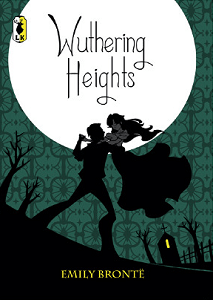
Wuthering Heights by Emily Brontë
Published December 1847 by Thomas Cautley Newby
Classic/Romance
Format: Paperback; 308 pages
Also From This Author: Poems By Currer, Ellis, and Acton Bell
Goodreads | Amazon
My Rating: 3/5

Before I finally post my last, lingering thoughts on Wuthering Heights, I feel like I need to say something about my month-long absence from blogging. January was a rather tough month for us in many ways, and I think the stress finally took its toll on me both physically and emotionally, so I basically “checked out” in February. My life revolved around working, watching the Olympics (Go Team U.S.A.! Yes, I am a huge Olympics fanatic), reading, and focusing on my responsibilities here in Grenoble. Also, I have been sick three times this month (guess that’s a side-effect of working with children). BUT, I am back and even though I am forcing myself to write and publish this last Wuthering Heights post, I am ready to dive back into the blogosphere with some exciting posts (such as my thoughts on Northanger Abbey, which I currently have my nose in, as well as a fun challenge I am giving myself for my birthday next week!).

wutheringheightsSo, let’s discuss how I felt about Wuthering Heights the second time around! But first, here are links to my previous posts:

Chapters I-IX
Chapters X-XVII
Chapters XVIII-XXVI

[Spoilers ahead, beware!]

This section starts off with one of the most suspenseful sections in the novel. Cathy, in her naivety and gentleness, is lured by Linton to Wuthering Heights, where Heathcliff essentially takes her prisoner. His intentions are obvious to the reader: he wants Cathy and Linton to become married. The worst part about this section is not the forced marriage, but the fact that Edgar Linton is on his deathbed and Cathy is afraid she will be unable to see him before he dies since Heathcliff refuses to let her leave.

“Mr. Heathcliff, you are a cruel man, but you’re not a fiend; and you won’t, from mere malice, destroy, irrevocably, all my happiness.”

Oh he would, but fortunately that doesn’t happen. Catherine is reunited with her father just before he dies, and finally Heathcliff becomes the master of both Wuthering Heights and Thrushcross Grange. Shortly afterwards, Linton dies as well, which is a sad passage considering that Heathcliff’s neglect is mostly responsible. At this point Nelly’s narration ends as we have arrived at Mr. Lockwood’s arrival, and we dare to ask ourselves, “What’s next?” in Heathcliff’s schemes.

Mr. Lockwood now decides to leave Thrushcross Grange, and I honestly can’t blame him, but before he leaves he visits Wuthering Heights one last time and we can now reconcile the Heathcliff, Hareton, and Cathy that we met at the novel’s beginning with those of Nelly’s narration. We see how cruel Cathy has become towards her cousin Hareton, and even though I never stopped desiring a happy ending for Cathy, I did sympathize with Hareton a great deal. I felt that he and Linton were the two extremes of the same spectrum: both were abused and neglected by Heathcliff, both were unloved by their fathers, and both sought the attentions of young Cathy Linton, yet we find that Hareton had a much stronger spirit than Linton. I understand and sympathize with the fact that Linton was already a frail child before falling into Heathcliff’s clutches, where he was further abused and terrified, but the way he responds is not the same way that Hareton responds to his own sufferings. Linton, out of fear, does whatever his father asks of him, regardless of the consequences it has on others. Yet Hareton, who does obey Heathcliff for the most part, still has his own desires that ultimately control his destiny.

Now, for the long-awaited happy ending! After several months, Mr. Lockwood returns to Wuthering Heights where we find that Heathcliff has died (and is unsurprisingly mourned by no one). Yet, before he died, his behavior changed a great deal, and he let go of his desires to continue his revenge on Cathy and Hareton. We have Catherine Earnshaw Linton to thank for this: that morbid grave exhumation scene in Chapter 29 now seems to have a greater purpose than to further elaborate Heathcliff’s twistedness. The final chapters of the novel show a much pleasanter scene at Wuthering Heights: Cathy and Hareton, once at odds, are able to forgive and forget and move on (finally someone is able to!), and Nelly confesses to Mr. Lockwood that the two will soon be married (this even elicited a silent “aww” from me).

My second time reading this novel produced some interesting reactions. My hatred for Heathcliff and Catherine Earnshaw grew deeper, yet I was finally able to see an actual happy ending for two characters I ended up “rooting for” this time around. Honestly, I don’t think I will attempt to read this novel again for another 10 years, but I was glad to see that some people who were reading along with me actually enjoyed it! That is refreshing.

For those who have read Wuthering Heights, what were your final thoughts on the novel? Do you think it deserves to be canonized? What was the biggest take-away for you? (For me it was to forgive and forget! Honestly, all of that bitterness and thirst for revenge seemed so exhausting)

Wuthering Heights Chapters XVIII-XXVI

wutheringheightsWeekly Schedule
Chapters I-IX
Chapters X-XVII

[Spoilers for Chapters 18-26 of Wuthering Heights]

Today was gloomy and drizzly, perfect Wuthering Heights weather, and I spent a few hours this afternoon powering through this week’s chapters. Even though there was significantly less drama, we were introduced to two “new” characters, one of which I actually like! Even though Mr. Lockwood meets Cathy Linton when he first visits Wuthering Heights, we don’t immediately find out much about her, except that she’s Heathcliff’s daughter-in-law. Our section this week picks up 12 years after the deaths of Catherine Earnshaw-Linton and Hindley Earnshaw. Nelly right away describes that those were the happiest 12 years of her life, and why would that be? Because Heathcliff is absent! It was nice for me as well, I must say. But besides that, Nelly is also the nanny to little Cathy Linton, whom I really like, despite the fact that she doesn’t listen to Nelly or her Father when they tell her to stay away from Wuthering Heights (but who can blame her, honestly, when she’s forbidden from visiting without really knowing why?). She’s still a good-natured and good-tempered girl (at least compared to her mother).

Nelly narrates the happenings of the next 5 years, up until Cathy is 17 years old (which we learn was a little more than a year before Mr. Lockwood’s arrival). For the most part, Cathy’s life is rather uneventful, that is until her Aunt Isabella dies and Edgar brings home his nephew Linton Heathcliff to stay with them. Cathy is right away enraptured–she immediately loves her cousin and can hardly wait to become best friends with him. Unfortunately, nothing good lasts in this story, and Heathcliff sends Joseph (ugh) to–and I’m basically paraphrasing it here–fetch back his property to Wuthering Heights. Now, young Linton is a sickly boy with a fair complexion and a rather weak-spirit. He resembles his father in no way whatsoever, so right away we know that things are not going to end well for Linton.

Cathy, of course, is heartbroken, but she continues on her life until a few years later when her and Nelly run into Heathcliff not far from Wuthering Heights, and he tricks persuades Cathy to come visit. Nelly, essentially powerless at this point, tries desperately to dissuade Cathy, because she knows that Heathcliff is up to no good. But once Cathy is reunited with Linton the damage is done, and unfortunately for everyone involved (including us readers), Heathcliff now has power over Cathy as well, and his vengeful plan is now all set to snowball into an avalanche and ruin everyone’s lives–*breathes*–ok, it’s clearly obvious I hate Heathcliff.

Heathcliff effortlessly persuades Cathy and Linton into falling in love, but I’m guessing that, based on all of the other romantic relationships here, it is NOT going to end happily-ever-after. My guess is that Linton is going to succumb to his illness in a matter of pages and Cathy (who may actually love him, who knows? At least she’s nice to him) will turn into the apathetic Cathy we met at the beginning of the novel.

My favorite part of this section was finally seeing a child actually being loved and cared for. Edgar, despite his cruelty towards Heathcliff during their adolescence, is actually a doting father who loves and admires his spirited daughter. Nelly is also a loving and practical nurse who does not treat Cathy wrongly, but who really wishes her to be safe and happy. Cathy turns out to be a thoughtful and agreeable young lady, her only faults being that she’s overly curious and likes to run off to tend to her sick cousin and then lie about where she’s been. In her we can see a kind heart.

I have completely forgotten how this novel ends, but right now I’m earnestly hoping that Cathy gets some type of happy ending. I think it’ll be the only thing that can redeem this novel for me.

For those reading along with me: how do you feel about Cathy Linton and Linton Heathcliff, both as individual characters and as a romantic pair? Do you agree with Cathy’s statement that her and Linton would never quarrel after they were married and used to each other (Ch. 23)?

Post your thoughts in the comments, or share the link to your own blog post :)

Wuthering Heights Chapters X-XVII

wutheringheightsI apologize for not posting this much earlier in the week. The past five days have been rather taxing on me, both mentally and emotionally, and I have been trying to keep up with all of my responsibilities as best as I can. Heureusement (as the French say), the only thing I didn’t manage to complete this week was my Wuthering Heights post, but here it is now!

[Spoilers for the first half of Wuthering Heights]

I was really immersed in this week’s chapters for some reason, and I even stayed up rather late on Saturday reading through the end of Chapter 17. For those of you who are reading along with me, or if you are very familiar with Wuthering Heights, you may be asking, “What did you find so enjoyable about all of that?” And I will borrow the words of Cleo at Classical Carousel and say that the drama in this novel is very much like a car wreck you cannot look away from.

Nelly Dean’s story continues with Heathcliff’s return. She discloses that she does not know how he spent those three years away, nor how he made his wealth, but one thing is for sure: Heathcliff and Catherine are still infatuated with each other, and they seem to take some type of sadistic pleasure in how their outwardly affections distress Catherine’s husband, Edgar.

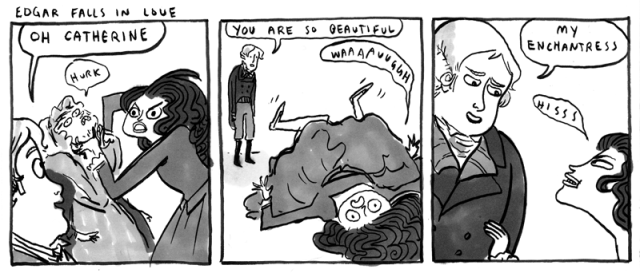
Heathcliff, who seems to have become a gentleman in his absence, begins spending a good amount of time with Catherine and her sister-in-law, Isabella Linton. Isabella–poor, naive Isabella. Don’t we all just pity her? Blindly, she “falls in love” with Heathcliff, and is then harshly teased about it by Catherine and even Heathcliff himself (but does this change Isabella’s heart? Nope. She runs off and marries Heathcliff later on…). That teasing scene is probably my least favorite involving Catherine Linton. The only thing more cruelly selfish than exposing Isabella like that is when she maliciously decides to break her own heart in order to break Edgar and Heathcliff’s hearts. Honestly, what does Edgar see in her? Heathcliff’s obsession with her is more understandable, but why, Edgar? Why? This comic from Hark! A Vagrant sums it up perfectly:

Catherine

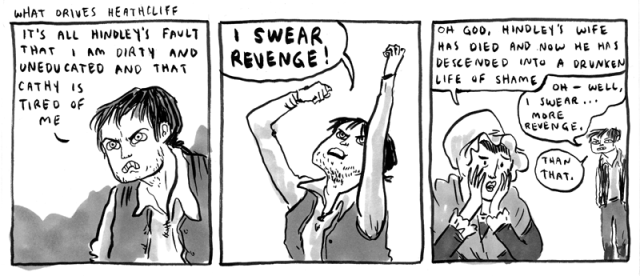
And Heathcliff is just as violent as Catherine, although he has the “tortured Byronic hero” thing going for him (but I have yet to discover any redeeming qualities about him–are there any?). It is clear during this entire section of the novel that Heathcliff has developed a consuming desire for revenge. All of his actions are governed by the same thought: “How can this hurt those who have hurt me?” And he doesn’t just want to hurt his former oppressors once; no, he wants to control everything about them, basically putting them in the place that adolescent Heathcliff was forced in by Hindley. This is why he marries Isabella, so he can become Edgar’s heir, and it’s clearly why he wants guardianship of Hareton. He says so himself at the end of Chapter 17, when Nelly comes to collect Hareton back to Thrushcross Grange:

“Now, my bonny lad, you are mine! And we’ll see if one tree won’t grow as crooked as another, with the same wind to twist it!” (172)

Heathcliff

Nelly, who views Heathcliff as a nightmare, described his presence perfectly back in Chapter 10:

“His visits were a continual nightmare to me; and, I suspected, to my master also. His abode at the Heights was an oppression past explaining. I felt that God had forsaken the stray sheep there to its own wicked wanderings, and an evil beast prowled between it and the fold, waiting his time to spring and destroy” (98)

‘Evil Beast’ and ‘Heathcliff’ are names I should use interchangeably from now on.

So, by the end of Chapter 17 Heathcliff has returned for a year, and in that time he ran off and eloped with Isabella, whom he then tormented until she finally flees, he fights with Edgar, which causes Catherine to became ill and later die during childbirth, and if that’s not enough, it also appears that Heathcliff is responsible for Hindley finally drinking himself to death sooner rather than later.

But this section isn’t all bad. Heathcliff speaks some of those heart-wrenching romantic lines I enjoy for some reason, like when he discloses to Nelly that he would never have harmed Edgar or “touched a single hair of his head” (136) because it would cause Catherine to suffer. Although Heathcliff would have killed Edgar the moment Catherine stopped caring for him, the fact is that Edgar physically assaulted Heathcliff, and not the other way around. Maybe this is supposed to convince us that Heathcliff genuinely and selflessly loves Catherine? I’m not going to agree with that until I finish this novel–nothing is for certain at this point except that Heathcliff is still seeking revenge!

What do you think of Heathcliff’s revenge thus far? Do you sympathize with him or do you want to chuck your book at his head? And whose story is the saddest so far: Hindley’s, Isabella’s, Edgar’s, or Catherine & Heathcliff’s?

[Also, if your edition does not include a translation for Joseph’s speeches (which I’ve stopped trying to decipher on my own), this is a great site to refer to: http://www.wuthering-heights.co.uk/josephs-speech.php It also has a lot of other interesting resources to check out.]

Wuthering Heights Read Along: Chapters I-IX

wutheringheightsI was somewhat doubtful at my ability to get this post up tonight, but fortunately I got really immersed into the last few chapters of this week’s reading and was able to speed through it on my way home from Philadelphia tonight! I was in Philly today visiting my uncle and his family (whom I haven’t seen since my wedding two years ago!), and the frigid, dreary weather set the perfect atmosphere for Wuthering Heights. January’s are known to be wet and cold, and that is why I chose this month to schedule a read-along; I love seasonal reading! So, let’s get down to discussing all of the perturbing details of Wuthering Heights! [Spoiler Alert for Chapters 1-9 of Wuthering Heights]

I did not look at where Chapter 9 would leave us plot wise before I set the weekly chapter numbers; I just divided the book up equally between four weeks. But after finishing Chapter 9 I realized this was a perfect resting place. But let’s go back to the beginning, shall we? I mentioned in an earlier post that the first and last time I read Wuthering Heights was ten and a half years ago, and even though I liked the novel at the time, I could not make myself relate to, sympathize with, or even like our two tragically selfish characters, Heathcliff and Catherine Earnshaw. Delving into this reread, I’ve realized that, even though the characters are still unlikable for me (especially Cathy), I am actually very into the novel so far!

We follow the diary entries of a Mr. Lockwood, who just became the tenant of Heathcliff, our Byronic hero. Right away we get to meet Heathcliff and the rest of his household, and Emily Brontë immediately introduces this motif of chaos, specifically with character confusion. If you don’t pay close attention, it can be tricky figuring out who is who as well as how everyone is related to each other. If my memory serves me correctly, it will get harder later on when we have two Catherines and two Heathcliffs, on top of all the Lintons and Earnshaws that are involved. If you are already familiar with this novel, or if you don’t mind some spoiling, you can check out this character map to aid any confusion you may have :)

We take on the point of view of Mr. Lockwood as we become acquainted with Heathcliff, his daughter-in-law Catherine Heathcliff, Hareton Earnshaw (later revealed to be Catherine H.’s cousin), and the…interesting…servants. Between the hostile dogs and the eerie ghost dreams, I found myself wanting to flee Wuthering Heights nearly as much as Mr. Lockwood did.

I was much more into the next several chapters, when Ellen ‘Nelly’ Dean begins her narration of Heathcliff’s upbringing. This is the part that helps me sympathize with Heathcliff. It helps me reconcile the harsh and unfeeling land lord with the abused and ridiculed orphan boy who needs a hug at one moment and a slap the next. The only person who seems to understand or connect with him is Cathy Earnshaw, but their relationship is no picnic. It is tortured and strongly corrupted by the pitfalls of human nature. One thing I do appreciate about their relationship, however, is that it seems to be sadly realistic–something that could happen to some unfortunate couple. This is no fairy tale.

The most fundamental section of this week’s reading for me was Chapter 9, when Cathy E. reveals to Nelly her recent engagement to Edgar Linton before bluntly confessing her love for Heathcliff. Here we see an honest part of Cathy. She is a complex character: at home she acts in a mischievous and immature manner which she quickly covers up with a charming and attractive façade whenever in company with the Lintons. During this confession scene, we get to see an honest part of Cathy’s character. Unfortunately, due to her harsh delivery of words and the fact that she is unaware that Heathcliff is within earshot, she declares that it would degrade her to marry Heathcliff. At this insult, Heathcliff flees Wuthering Heights, and the most tragic part is that it is just before Cathy makes this beautifully heartfelt speech, which I will quote bits and pieces of here:

“It would degrade me to marry Heathcliff now; so he shall never know how I love him: and that, not because he’s handsome, Nelly, but because he’s more myself than I am. Whatever our souls are made of, his and mine are the same; and Linton’s is as different as a moonbeam from lightning, or frost from fire…My great miseries in this world have been Heathcliff’s miseries, and I watched and felt each from the beginning: my great thought in living is himself. If all else perished, and he remained, I should still continue to be; and if all else remained, and he were annihilated, the universe would turn to a mighty stranger: I should not seem a part of it.—My love for Linton is like the foliage in the woods: time will change it, I’m well aware, as winter changes the trees. My love for Heathcliff resembles the eternal rocks beneath: a source of little visible delight, but necessary. Nelly, I am Heathcliff! He’s always, always in my mind: not as a pleasure, any more than I am always a pleasure to myself, but as my own being.”

I know that’s a long passage, but how beautiful and moving it is! And just after it we find that Heathcliff has disappeared and Cathy immediately goes into despair. Three years pass, Cathy marries Edgar, and Nelly’s narration comes to a pause as Chapter 9 draws to a close. WHAT HAPPENS NEXT?? I honestly can’t remember, and I really want to know!

So, to wrap up this long post, let me ask you all some questions:

  • What do you think about Cathy’s engagement to Edgar? Do you think her reasons for marrying him are naive, immature/shallow, or unselfish?
  • I talked about how confusing this novel can be at times. Are there any areas that have confused you thus far?
  • What are your feelings regarding our seemingly doomed lovers, Cathy and Heathcliff?

If you are reading along with us or if you have already read Wuthering Heights, post your thoughts/blog link in the comments below! And check back in a week for my thoughts on Chapters 10-17 :)

Announcing: Wuthering Heights Read-Along

WutheringHeightsA few months ago I participated in a Jane Eyre read-along hosted by the lovely Kerry at Entomology of a Bookworm. It was my first time reading Charlotte Brontë’s beloved novel, and I came to adore it so much that I decided to give her sister Emily’s novel, Wuthering Heights, a second chance. The first and only time I read Wuthering Heights was in 2003, back when I was just a freshman in high school. At that time I enjoyed reading it, despite my dislike for the main characters. But as the years passed, I came to really despise them and I put off any desire of ever reading the novel again.

Fortunately, thanks to the skill and beauty of Charlotte Brontë’s writing, I have decided to give Wuthering Heights a well-deserved second chance. I know that Emily Brontë writes beautifully as well, and at least now that I know what to expect from the main characters, I will not be disappointed. Also, what is the new year for if not to start over fresh? ;) Now I am actually quite excited to revisit this tortured love story!

And to make it even more exciting, thanks to the encouragement of my good friend Jorie at Jorie Loves a Story, I have decided to turn this into a group read along! Whether you are like me and you want to give Wuthering Heights a second chance, or if you’ve never read it, OR (and especially) if this is your favorite novel of all time, I’d love for you to join in with me!

Here is the tentative schedule (I say tentative because we all know how hectic the holiday season can get!)

Week 1 (January 5-January 11): Chapters I-IX
Week 2 (January 12-January 18): Chapters X-XVII
Week 3 (January 19-January 25): Chapters XVIII-XXVI
Week 4 (January 26-February 1): Chapters XXVII-XXXIV (End)

Let me know in the comments if you would like to join in! I think January is going to be a wonderful time to read this novel :)

The Legend of Sleepy Hollow and Recycling in the Disney Animation Department

SleepyHollowThe Legend of Sleepy Hollow by Washington Irving
Published July 1820 by C.S. Van Winkle
Classic/Short Story/Suspense
Format: e-book; 102 pages
Also From This Author: Rip Van Winkle
Goodreads | Amazon
My Rating: 4/5

When I was a teenager I ran both Cross Country and Track, and because my Florida high school was practically in the middle of nowhere, we mostly ran down dirt roads and through the woods. There was one trail in particular that I always loved, and I nicknamed it The Sleepy Hollow Trail. Picture this (or take a look at the picture on the right, because it looked a lot like that minus the Headless Horseman): to get to this trail you had to run across (or jump over, if you’re cool like me) a narrow stream and then tread up a steep hill before you could enter the woods. The trail wove around tall trees, the branches of which blocked out most of the scorching Florida sunshine, creating a shady, damp, and breezy wooden environment. It was the perfect way to recuperate after a 5 mile run, especially since there was obviously no headless fiend chasing after me.

Fast-forward to this month, when I finally read Washington Irving’s The Legend of Sleepy Hollow for the first time, and I must say that I was humorously surprised. Up until now, I had only experienced the 1999 Tim Burton film, which I love, but now I can see that it is clearly only loosely based on the original text. Nonetheless, I still love the gothic Johnny-Depp-featured depiction, despite the fact that Ichabod Crane is not supposed to be this handsome:

IchabodCrane2

Ok, clearly I like the geeky ones

But what’s with this “recycling” in the Disney Animation Department I alluded to in the headline? Back in 1949, Disney produced an animated Sleepy Hollow film that is spot on, and Ichabod resembles every bit of his original character description: “He was tall and exceedingly lank, with narrow shoulders, long arms and legs, hands that dangled a mile out of his sleeves, and feet that might have served for shovels. His head was small, and flat at top, with huge ears, large green glassy eyes, and a long snipe nose, so that it looked like a weathercock perched upon his spindle neck, to tell which way the wind blew.” Yeah, I’d much rather look at Johnny Depp.

However, something that my husband and I both picked up on while watching this movie (and I know we are not the first ones to make this connection) is the uncanny parallel between it and Disney’s Beauty and the Beast. Excepting the fact that Belle is beautiful (literally and etymologically) while Ichabod is…lanky, they are both bookish, awkward, and also happen to have run-ins in the woods with frightening creatures.

BelleIchabod

“Look there [he] goes that [man] is so peculiar…”

But the most incredible similarity was not between Belle and Ichabod, but between Gaston and Ichabod’s counterpart, Brom Bones, who is basically Gaston sans a hunting rifle and Le Fou. Perhaps that’s what an extra dozen eggs a day gets you? Besides the obvious similarity in looks, these two brawny villains also loved to rile up the villagers with their “It’s a Beast!” battle cries in a final desperate attempt in vanquishing rival suitors. Spoiler alert: it only worked for one of them.

DisneyConfessions

But apparently Beauty and the Beast isn’t the only Disney film to have borrowed from Sleepy Hollow…check out where Cinderella, released just one year later in 1950, got the inspiration for her original pink ball gown from:

KatrinaCinderella

Fortunately Cinderella only borrowed Katrina Van Tassel’s style…

Now everyone who knows me knows that I love all things Disney. I don’t even care that they recycled some of their own ideas. At least they threw in some catchy songs that I don’t mind having stuck in my head (“No one hits like Gaston, matches wits like Gaston; in a spitting match, nobody spits like Gaston…”).

And I really did enjoy The Legend of Sleepy Hollow. It was a quick read (it is only a short story after all), plus multiple parts had me chuckling while the climatic action at the end created a nice amount of suspense. Perfect October reading :)

[Here’s a link to the 30-minute 1949 version of Sleepy Hollow on Youtube, for those who are interested in finding more Disney film parallels: http://www.youtube.com/watch?v=dxX66vLSZoQ]

Also, has anyone watched the new Sleepy Hollow tv series? I kind of want to give that a try…

→UPDATE Oct. 25: This week Oh My Disney (an official Disney blog) posted this article about Sleepy Hollow, and they even addressed the Cinderella and Beauty and the Beast similarities. 

Also, I started watching the Sleepy Hollow TV series and I love it! Very loosely based on the original story, but the acting is wonderful :)